
Frontline Learning Research Vol.13 No. 4 (2025) 39 - 67
ISSN 2295-3159
1Ruhr University Bochum, Institute of Educational Research, Bochum, Germany
2Center for Advanced Internet Studies (CAIS), Bochum, Germany
Article received 20 January 2025 / revised 6 November 2025 / accepted 7 November 2025 / available online 10 June 2026
The present study addresses an important yet underexplored area in learning research: how learners conceptualize scientists beyond the natural sciences. While previous studies have extensively examined learners' perceptions of natural scientists, little is known about their understanding of social and educational scientists. These fields are often overlooked as scientific domains and are not typically associated with competence. Given the potential influence of such conceptions on learners’ academic engagement and career aspirations, this interview study provides an in-depth exploration of learners’ conceptions of educational scientists. A qualitative content analysis reveals that learners predominantly envision educational scientists as pedagogical practitioners requiring interpersonal skills to support children in educational or social institutions. An additional typological content analysis shows that learners who associate educational scientists with scientific activities tend to hold vague and uncertain ideas about the actual nature of this scientific work, calling into question whether it can really be considered research. Such conceptions appear to be rooted in learners’ school experiences. These findings highlight a significant gap in learners’ understanding of educational scientists and their work, as well as the potential consequences of this gap for engagement with the social sciences. This underscores the need for social and educational science instruction in schools to clarify and convey the scientific nature of knowledge generated in these disciplines. Overall, this study emphasizes the need for targeted interventions to foster accurate conceptions about educational scientists, which ultimately could enhance learners’ appreciation of the social sciences and support more informed academic and career choices.
Keywords:Images of educational scientists, perception of educational scientists, social science education, interview study, qualitative content analysis, epistemic network analysis, typological content analysis
Educational science, and social sciences in general, seem to face an image problem. Not only are they often classified as “soft” sciences (see, e.g., Light et al., 2022), but they are also rarely associated by the public with the terms “science” or “research” (Ziegler et al., 2018) or with scientific professions (Gligorić et al., 2022). Regarding educational science, both laypersons and academics perceive it as one of the disciplines requiring the least brilliance from its professionals when compared to other scientific fields (Leslie et al., 2015; Meyer et al., 2015). University students also attribute a higher degree of warmth (e.g., social skills) and a lower degree of competence (e.g., cognitive skills) to the educational science domain than to physics (Heyder & Kortzak, 2024), and high school students in Germany tend to view educational science as a "Laberfach" (Baumgart & Bubenzer, 2001), meaning that the school subject is easy to pass by talking or waffling. As these findings suggest, educational science is not associated with science and more particularly a “hard-to-do-science”, as Berliner (2002) states about the work of educational researchers. As the previously introduced surveys of German, British, and American laypersons, academics, university students, and school students show, this non-scientific view of educational research and the perception of educational science as “easy-to-do-science” (Berliner, 2002) appears to be neither culturally specific nor bound to certain age groups.
This issue has been acknowledged for decades. Kaestle (1993) already discussed reasons for “The Awful Reputation of Education Research”, including the lack of consensus in goals and findings, limited funding, and weak connections between research and practice. The latter has since been emphasized repeatedly (e.g., Burkhardt & Schoenfeld, 2003; Vanderlinde & van Braak, 2013) and is mirrored in the negative attitudes of preservice and practicing teachers towards educational research (e.g., Merk et al., 2017; Guilfoyle et al., 2020). Thus, non-scientific and negative perceptions of educational research may reduce the uptake of research findings in educational practice and policymaking, thereby diminishing the discipline’s societal impact. To address this, Oakes (2018) advocates for stronger partnerships between educational researchers and publics, as well as for more effective communication of research findings. This ongoing debate highlights that the image problem of educational science influences the discipline’s visibility, credibility, and impact across society.
These limited societal impacts, along with the disparaging view of educational science, likely also affect school students in their learning trajectories. Science education research has shown that learners' conceptions of the work and characteristics of (natural) scientists affect their disciplinary interest and classroom performance (Hong & Lin-Siegler, 2012; Lin-Siegler et al., 2016), as well as their study and career choices, particularly when these conceptions conflict with their self-image (McPherson et al., 2018). This phenomenon, referred to as the self-to-prototype matching strategy (see Setterlund & Niedenthal, 1993), suggests that learners base their academic and career commitments on their perceptions of typical professionals in a field. Thus, it is crucial to investigate how learners conceptualize professions within disciplines. However, prior research has primarily examined these processes in the context of natural sciences, leaving learners’ conceptions of scientists in the social and educational sciences largely unexplored. Against this background, in the present study, we investigate how learners conceptualize educational scientists and, thus, scientists beyond the natural sciences.
With regard to learners’ images of (natural) scientists, ample research has demonstrated that these images are often confused, inaccurate, and stereotypical (e.g., Christidou, 2011; Miller et al., 2018; Thomson et al., 2019; Stamer et al., 2019; Ferguson & Lezotte, 2020). Inaccurate and stereotypical portrayals of natural scientists are often hypothesized as contributing to students abandoning science, either because they perceive themselves as not intelligent enough (see, e.g., McPherson et al., 2018), or – particularly in the case of female students – because they associate the field with masculine traits and thus consider it an unsuitable career path (see, e.g., Cundiff et al., 2013). Conversely, the disparaging perception of educational science, and in particular its weak association with rigorous research, may deter students who are genuinely interested in scientific inquiry. Instead, it may attract those who just like to read (see Pauly, 2012) and seek an “easy-to-do” study program.
In this context, we conceptualize “science” not merely as a set of disciplines, but as a knowledge-generating practice involving diverse forms of inquiry and empirical methods aimed at explaining, predicting, or understanding phenomena, and culminating in theories, models, and knowledge claims (see Irzik & Nola, 2011). This definition highlights the methodological core of science – regardless of disciplinary boundaries – and underscores why the perception of educational science as “non-scientific” is consequential. It suggests that what is at stake is not just disciplinary prestige but students’ understanding of how knowledge is produced, evaluated, and legitimized across different fields. Understanding how learners conceptualize educational scientists is therefore essential, not just to grasp potential barriers to student engagement with the field, but also to inform strategies for strengthening the discipline’s appeal and intellectual legitimacy.
However, while some initial research has been conducted on students’ and other peoples’ broader views of educational science as a domain, to our knowledge, no study has yet provided a detailed and differentiated understanding of students’ conceptions of educational (or social) scientists as professionals.
We have begun to address this gap. More specifically, we compared learners' conceptions of educational scientists between students with different levels of interest and self-image in educational science (Nachtigall & Rummel, 2025), based on coded data from a semi-structured interview study with 64 secondary school students. We found significant differences, namely that students with high interest and self-image had more inaccurate conceptions than students with low to moderate interest and self-image, as they viewed educational scientists more as pedagogical professionals with interpersonal skills than as researchers with cognitive skills. Another survey study we conducted showed similar results for students’ conceptions of scientists within social sciences and humanities more generally (Nachtigall & Rummel, 2020). These findings support the claim that social sciences and humanities are studied by “the wrong people for the wrong reasons” [translated from German, see Pauly, 2012, p. 209], and suggest the need to develop and test targeted interventions to promote more accurate student conceptions of educational scientists and social scientists more generally.
To develop effective interventions, however, it is necessary to first gain a more nuanced understanding of how learners conceptualize scientists beyond the natural sciences. This is the primary goal of the present study. Through an additional analysis of our interview data, we aim to provide a more detailed and differentiated picture of students’ conceptions of educational scientists, offering insights that can inform future interventions.
Research on learners’ images of (natural) scientists has provided a wide array of insights into how children and students conceptualize scientists. This research has shown how learners think about the following aspects: (1) the appearance or looks of scientists, (2) their personal characteristics and skills, (3) the ways scientists work, (4) the places where scientists work, (5) the materials and equipment scientists use, (6) the evolution of scientists’ careers, and (7) the relevance of scientists and their work.
Regarding the appearance of scientists, a large body of research has shown that children and adolescents typically imagine scientists as male Caucasians who wear lab coats and glasses and tend to be older (e.g., Mead & Métraux, 1957; Boylan et al., 1992; Miller et al. 2018; Ferguson & Lezotte, 2020). With respect to their personal characteristics and skills, learners often think of scientists as dedicated and extraordinary intelligent, brilliant, and gifted geniuses who tend to be unsociable (e.g., Mead & Métraux, 1957; Finson, 2002; Larochelle & Désautels, 1991; Christidou, 2011). More recently, research has also begun to investigate what kind of emotions learners associate with scientists and their work (see Christidou et al., 2023), showing that children perceive scientists as mostly happy people due to the assumed self-efficacy they experience during their work. With regard to the ways how scientists work or in what kind of activities they engage, learners usually think of laboratory tasks, especially the conduction of experiments (e.g., Mead & Métraux, 1957; Boylan et al., 1992; Wentorf et al., 2015). Consequently, students usually associate a laboratory or indoor setting with the place where scientists work (e.g., Boylan et al., 1992; Christidou, 2011; Miller et al., 2018; Ferguson & Lezotte, 2020), as well as laboratory equipment and instruments with the materials that scientists use (e.g., Mead & Métraux, 1957; Finson, 2002; Christidou, 2011). A few studies provide insights into how learners conceptualize both the evolution of scientists’ careers (including their motivation to become scientists) and the relevance of scientists and their work. That is, students tend to think that scientists undergo long and hard training (Mead & Métraux, 1957), that their motives for becoming scientists are either to satisfy a personal thirst for knowledge (Larochelle & Désautels, 1991; Höttecke, 2001) or to serve society (Mead & Métraux, 1957), and that the work of scientists contributes to the development of innovations that benefit human life (Mead & Métraux, 1957).
Sources of such conceptions are assumed to be related to the representation of scientists in media (e.g., Solomon, 1993; Finson, 2002; Christidou, 2011; Tan et al., 2017; Miller et al., 2018) and in part also to the experiences of learners in class (e.g., Schoenfeld, 1988; Larochelle & Désautels, 1991). How learners conceptualize scientists can, in turn, affect their learning and performance in class as well as their interest in science and a scientific career.
Regarding the appearance of scientists and especially the idea that scientists are male, gender research studies suggest that implicit gender stereotypes regarding scientific fields, such as associating natural sciences with men and humanities with women, can impact students’ career choices (e.g., Lane et al., 2011; Cundiff et al., 2013): Male students who hold these stereotypical views are more likely to pursue careers in the natural sciences, while female students with similar implicit biases are less inclined to consider careers in these fields. In contrast, the stereotypical view of scientists, as captured by the widely used Draw-a-Scientist Test, has been found to be unrelated to students’ career aspirations (Toma et al., 2022). In addition to investigating these relationships, previous research has also focused on investigating possible learner characteristics that could have an influence on perceptions of scientists. For example, the meta-analysis by Miller et al. (2018) focuses on the influence of students’ gender and age on their perceptions of scientists. The results show that male students draw male scientists more often than female students. In addition, the drawings of older students more often contain stereotypical characteristics (e.g. male, lab coat and glasses) than the drawings of younger students. Another influencing factor that is the focus of some studies is the cultural background of learners. For example, Finson (2003) examined the number of stereotypical features in the drawings of eighth graders who were either “Caucasians”, “Native Americans” or “African Americans”. The results showed no differences between the three groups.
With regard to the personal characteristics and abilities of scientists and in particular the image of scientists as highly intelligent geniuses, a problem may arise from discrepancies between learners’ conceptions of scientists and their self-image. Knowing that famous scientists were not consistently successful geniuses but sometimes failed and struggled in their work and lives can increase students’ interest and learning in science, as shown by the studies of Hong and Lin-Siegler (2012) and Lin-Siegler et al. (2016).
Cheryan et al. (2013) found that the perception of computer scientists as geeks, who are highly intelligent but socially unskilled and solely focused on their computers, negatively affects female students’ interest in majoring in computer science. As research on students’ images of scientists has shown, students also often think of scientists as socially unskilled and isolated people who conduct experiments alone in a lab and focus solely on their work, which may discourage more people-oriented individuals from studying and majoring in science. Thus, not only perceptions of scientists’ appearance and abilities, but also perceptions of scientists’ work and working environments are likely to affect students’ interest and learning.
Research by Diekman et al. (2010) and Brown et al. (2015) illustrates that specific perceptions about scientists’ motivations and the relevance of science can significantly influence students’ interest in science, particularly in pursuing STEM careers. These studies reveal that when students believe scientists and their work serve communal or socially beneficial goals, their interest in pursuing STEM careers increases.
Thus, a long tradition of previous research has provided extensive insights into how learners conceptualize various aspects related to the work and personal characteristics of (natural) scientists, and how these conceptions affect their academic and career choices. Against this background, it seems interesting and necessary to extend this research by investigating how learners conceptualize the work and characteristics of scientists in other disciplines beyond the natural sciences. This knowledge could inform targeted interventions to both prevent stereotypical, confused, and inappropriate conceptions of scientists and to change existing misconceptions. Given the disparaging view of educational science as a discipline and domain introduced earlier, the present study aims to investigate how learners conceptualize different aspects related to the work and characteristics of educational scientists (Research Question 1).
In addition to the extensive body of research on how learners perceive various aspects of the work and personal traits of (natural) scientists, some studies have specifically examined the types of scientist images that emerge from these learner perceptions.
Chambers (1983) started from children’s drawings to identify “the standard image” of a scientist, who wears a lab coat and eyeglasses, has facial hair, and is surrounded by laboratory equipment. In addition, Chambers (1983) found different but less frequent “alternative images” referring to mythic representations of scientists as immoral (e.g., drawings referring to Frankenstein), magical (e.g., drawings showing an alchemical lab) or dangerous (e.g., drawings illustrating bombs and war).
Solomon (1993) classified the following four images of scientists based on interviews with younger children and adolescents: (1) The weird scientist who conducts dangerous and surprising experiments and whose work has no value for society, (2) the authoritative and helpful scientist who might be a doctor or a teacher and tests and explains things for society, (3) the technologist scientist or engineer who develops, tests, and improves artefacts for society, and (4) the intellectual scientist who is interested in developing ideas and testing them in experiments.
Brumovska et al. (2022) used drawings, qualitative questionnaires, and interviews to distinguish five profiles of primary school students’ perceptions of scientists: (1) The brainy scientist is a highly intelligent genius and perfectionist who does not like to fail, is dedicated to his work, and shy; (2) the crazy scientist is obsessed with explosions but happy, kind, and likeable; (3) the supernatural scientist either fights against evil supernatural creatures or is dangerous and evil with supernatural attributes or creating supernatural creatures; (4) the clumsy scientist is incompetent and often fails, resulting in dangerous and risky situations; (5) the normal scientist mostly refers to a STEM professional who does research in a laboratory or teaches.
In summary, over the past 40 years, various research methodologies have been used to explore different types of learners’ conceptions of scientists. Despite some differences, these studies have produced fairly consistent typologies. These typologies offer detailed and differentiated insights into learners’ perceptions and can inform targeted interventions to address a wide range of misconceptions. Therefore, the second goal of the present study is to identify different types of learners’ conceptions of educational scientists (Research Question 2).
Against this background, the present study aims to investigate the following two main research questions (RQ): (1) How do learners conceptualize educational scientists with regard to the aspects that have been demonstrated to determine learners’ conceptions of (natural) scientists? (2) Which types of educational scientists can be identified in students’ conceptions?
In addition to addressing the two main research questions, we plan to conduct further exploratory analyses to examine how certain learner characteristics influence conceptions of educational scientists. This will help us better understand the underlying factors shaping students’ perceptions and the role that social and cultural contexts play in these conceptions. Two factors shown to significantly affect how learners conceptualize scientists – and that are particularly pertinent to our study – are gender (see Miller et al., 2018) and educational background (see Larochelle & Désautels, 1991). Specifically, we aim to compare students’ conceptions of educational scientists across gender groups (female and male) and between those with formal versus non-formal exposure to educational science. This latter comparison further extends previous research focused on learners’ images of natural scientists by exploring how students perceive professionals in a discipline they do not directly study.
To achieve these goals, the present study draws on a dataset that has previously been analyzed with a different focus. The earlier analyses, which compared learners’ conceptions across disciplines and in relation to study interest and self-image, are presented in Nachtigall and Rummel (2025). In contrast, the present study extends this work through an in-depth examination of learners’ conceptions of educational scientists, introducing additional fine-grained coding, a novel typological content analysis, and an exploration of social and contextual factors.
To investigate our research questions, we conducted semi-structured interviews with 64 upper-secondary students in grades 10 to 13 (age: M = 16.52, SD = 1.15). The sample included 38 female, 25 male, and 1 gender-diverse student. The interviews took place between April and September 2022 at an interdisciplinary out-of-school lab affiliated with a large German university. Of these students, 56 visited the university’s social sciences and humanities lab as part of their school courses – primarily educational science (n = 13 courses), but also psychology (n = 1 course) – and participated in a project on the distinction between causal and correlational evidence. These students attended the lab in intact class groups (n = 14), accompanied by their teachers. It is worth noting that in some German federal states, educational science is an optional subject at the secondary level. Additionally, eight interviews were conducted with students from three biology courses who visited a natural sciences lab focused on DNA extraction. Ethical approval for the study was granted by the Ethics Advisory Group of the university’s Department of Philosophy and Educational Research (Approval Number: EPE-2022-008).
It should be noted that we selected this group because, at least in the German context, upper secondary students make decisions about advanced courses that often align with their future academic interests. Schuhen and Schürkmann (2015) found that nearly 30% of students at this stage select courses based on their intended field of study. This suggests that students have already developed relatively concrete, albeit not final, ideas about their future academic paths. Therefore, this sample is particularly well-suited for investigating how students’ conceptions of scientists relate to their academic interests. While the present paper does not focus primarily on this relationship, it forms part of the typological content analysis included here and represents a central objective of the overarching research project.
The interview consisted of different subject-specific sections (i.e., educational, historical, and natural scientists) with a randomly varied order to counteract any sequence effects. However, in the analysis presented here, we focus on the interview section that asked learners to describe how they conceptualize educational scientists. The procedure of the interview followed Merton et al.’s (1990) principles of range, specificity, depth, and personal context for focused interviews. To obtain “a wide range of comments” (Merton et al., 1956, p. 60), we started each section of the interview with the following opener question: “Please describe how you imagine a [educational, natural, or historical] scientist. Both the person and their work.” Follow-up questions were used to (1) specify previous comments (e.g., “And what exactly do you mean by working with children, so what do you have in mind?”), (2) deepen certain aspects (e.g., “Why do you think it is important for them to have good language skills and to be able to communicate well?”), (3) get insights into the interviewee’s personal context related to certain aspects (e.g., “You're imagining a laboratory like the ones you see in movies. What kind of movies are you thinking of? And how do you know it from movies?”), or (4) move to other aspects (e.g., You said that they mainly solve formulas on blackboards. What do you think they need to be able to do this well?).
The follow-up questions, which referred to previous statements and preformulated aspects of the semi-structured interview guide, were only asked if the topics were not covered by the participant’s previous answers. For this purpose, the interview guide included a checklist of aspects that the interviewer could tick off during the interview. These aspects and follow-up questions were based on previous research on students’ images and conceptions of (especially natural) scientists (e.g., Mead & Métraux, 1957; Krajkovich & Smith, 1982; Chambers, 1983; Boylan et al., 1992; Finson et al., 1995; Höttecke, 2001; Christidou, 2011) and thus referred to (e.g., educational) scientists’ (1) external attributes (i.e., look), (2) personal characteristics, (3) practices/activities/tasks, (4) working environment (5) working materials, (6) career path and motivation for pursuing this path, and (7) relevance of scientists and their work.
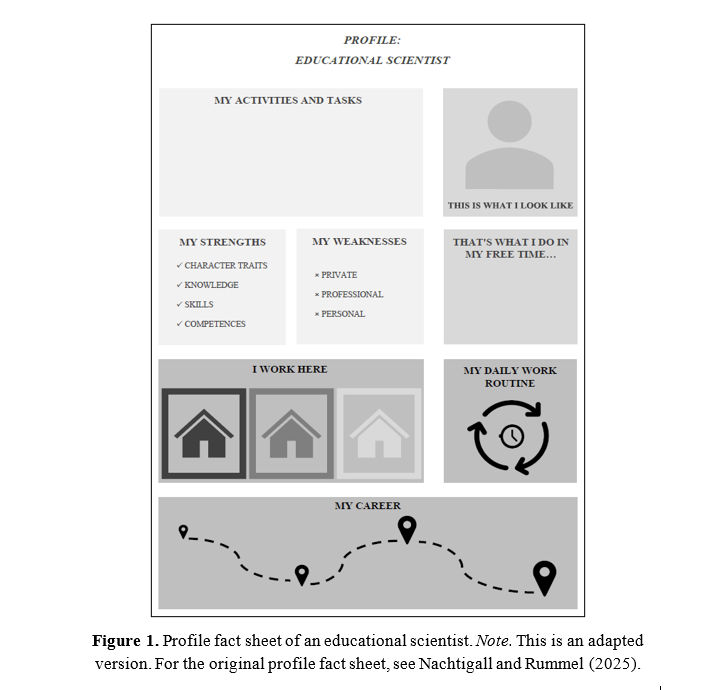
After conducting the first six interviews, we incorporated a profile fact sheet referring to the aspects of the interview guide (see Figure 1) as stimulus material to encourage students to talk on their own after responding to the opening question.
Qualitative Content Analysis: To investigate how learners conceptualize educational scientists with regard to different aspects related to their work and personal characteristics (RQ1), we coded the interviews following verbal data analysis (Chi, 1997) and qualitative content analysis (Mayring, 2014). We applied the first four steps of verbal data analysis as outlined by Chi (1997) and decided to (1) work with the full dataset without any reduction and (2) segment the data by sentences, resulting in 5,357 utterances. We then (3) developed a coding scheme and (4) ensured that contextual information from previous statements was incorporated to resolve ambiguities, following Chi's (1997) advice. We used the Reproducible Open Coding Kit (ROCK; Zörgő & Peters, 2023) for both segmentation and coding.
The coding scheme was developed in an iterative process. Initially, we applied a top-down strategy based on the interview guide, defining categories and coding rules deductively (Mayring, 2014). Following a preliminary examination, the categories were refined and expanded using an inductive approach (Mayring, 2014). Two student research assistants tested the coding scheme in two rounds (n = 5 and n = 13), which led to further revisions. The final version of the coding scheme consisted of 27 codes, which are detailed in the results section.
Given the development of a novel coding scheme, the context-sensitive nature of our coding process, and the exploratory character of the present research, our initial pilot testing yielded relatively low interrater reliability. As noted by Campbell et al. (2013), such outcomes are common when employing complex and individually customized coding schemes for analyzing data from semi-structured interviews. To address this, we implemented a negotiated agreement approach, in which two or more coders independently code the same transcript and then collaboratively review their decisions, engaging in discussion to resolve discrepancies and arrive at a final, consensus-based version (Campbell et al., 2013). In the current study, three raters worked in pairs to code the entire dataset, ensuring that all data were coded under the “four-eye” principle. Specifically, Raters A and B coded one-third of the transcripts, B and C another third, and A and C the final third. Any disagreements were resolved through discussion within each pair. Before these consensus discussions, the average interrater reliability across all 27 codes ranged from κ = 0.54 to κ = 0.59 across the three rater pairs – values indicative of moderate agreement (Landis & Koch, 1977). However, all coding discrepancies were resolved as a result of the negotiated agreement approach, leading to complete consensus across the dataset.
The coded data were analyzed using epistemic network analysis (ENA) (Shaffer, 2017) via the ENA web tool (https://www.epistemicnetwork.org/). ENA measures the co-occurrence of coded elements to identify connections and visualize them in dynamic network models (Shaffer et al., 2016; Shaffer & Ruis, 2017). In doing so, we follow the final steps of verbal data analysis, that is depicting, searching for patterns, and interpreting the data (Chi, 1997). The ENA algorithm constructs a network model for each line of data by showing how codes in the current line are connected to those in previous lines (e.g., Siebert-Evenstone et al., 2017). We used an infinite stanza window, which analyzes the connection of each line relative to all previous lines in the conversation (Zörgő et al., 2021). The ENA tool provides, among other things, mean network plots that show the average connections between the codes that students make during the interview. These networks are weighted, with darker, thicker lines representing more frequent and thus stronger connections between coded elements in the interview data, and lighter, thinner lines representing less frequent and thus weaker co-occurrences of codes within the interviews (Shaffer et al., 2016).
To gain a more detailed understanding of the coded data, a student research assistant conducted an additional round of inductive coding of the already coded data. For instance, all utterances that had been coded as statements referring to “scientific” activities were differentiated, based on the actual data, in further subcodes, such as “conducting experiments” or “doing research”. These additionally coded data are analyzed descriptively in the results section.
Typological Content Analysis: To investigate RQ2 and thus form a typology of learners’ conceptions of educational scientists, we employed Typological Content Analysis (Kuckartz & Rädiker, 2022). Accordingly, based on shared characteristics, elements are categorized into types (such as groups or clusters). Within each type, elements should exhibit a high degree of similarity, whereas elements belonging to different types should be as distinct and diverse as possible (Kuckartz & Rädiker, 2022). This involves comparing different cases and assigning them to specific patterns.
To develop a typology of learners’ conceptions of educational scientists, we followed the five phases of type formation outlined by Kuckartz and Rädiker (2022): (1) determining the feature space of at least two characteristics and summarizing how these features appeared in each case, (2) grouping similar cases, (3) deciding on the number of types and defining the formed types, (4) assigning cases to the types, and (5) analyzing the relationships between the typology and characteristics that were not used to form the types.
We determined the feature space both deductively from the results of the preceding content analysis and inductively by repeated reading of the transcripts. Two research assistants each summarized 32 cases, described the resulting types based on the previously determined feature space, and defined rules for assigning cases to the different types. The research team engaged in a continuous, dialogical process of joint interpretation. Their work was embedded in a collaborative framework, where the evolving type definitions and assignment rules were repeatedly discussed and refined. This iterative and consensus-oriented procedure included collective reviews of selected cases: first, by jointly examining and refining the typology across 26 cases, and then through additional team-based feedback sessions involving a third research assistant who contributed further perspectives to 22 selected cases. Thus, assignment decisions emerged from collaborative sense-making and shared interpretation.
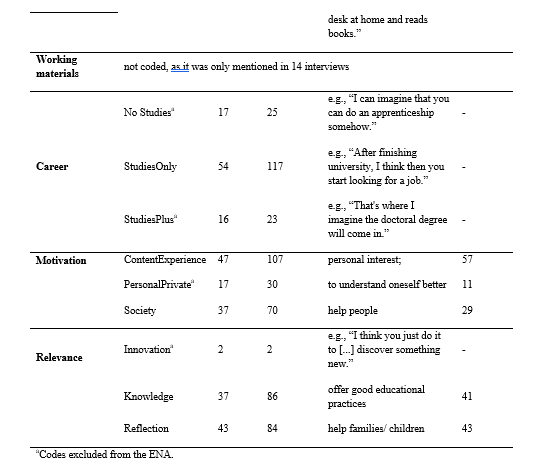
Regarding RQ1, we first describe the codes applied to the data and the most frequent statements belonging to these codes (see also Table 1) and then analyze their interplay using an ENA.
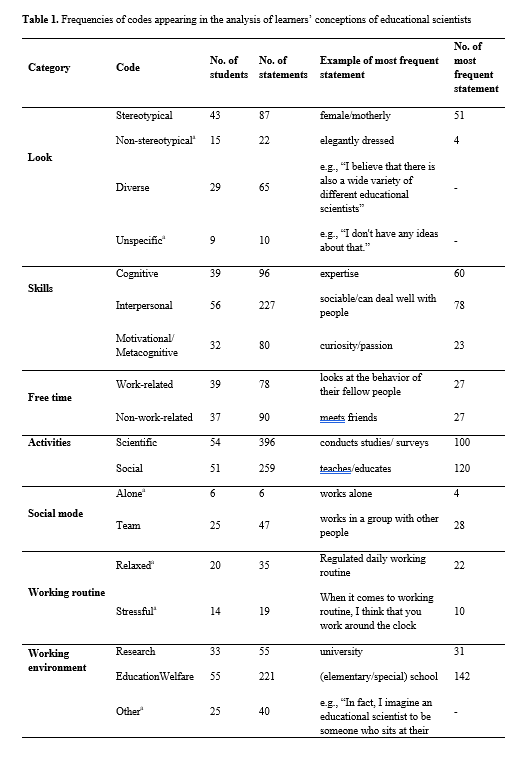
In terms of external attributes (i.e., appearance), we found that students described the appearance of educational scientists either in a stereotypical way (e.g., “a female or motherly person with a friendly face”), as diverse, or in a very specific but non-stereotypical way (e.g., “looks like my teacher” or “dressed elegantly”).
Three different types of skills and strengths comprise the personal characteristics that students attribute to educational scientists, namely interpersonal, cognitive, and motivational or metacognitive competencies. The most frequently mentioned interpersonal characteristics of educational scientists were “sociable” and “empathetic”. Statements such as “must have a high level of expertise” were coded as cognitive skills. In terms of motivational or metacognitive characteristics, students said that educational scientists need to be “curious” and “passionate” about their work and have “a lot of patience”. Other personal characteristics mentioned in the interviews related to students’ ideas about how educational scientists organize their leisure time. We divided their ideas into two categories: work-related and non-work-related free time. That is, students mentioned that educational scientists either can (“meet their friends”) or cannot (“look at the behavior of their fellow people”) balance their work and personal lives.
We categorized the practices, activities, or tasks that students associated with the work of educational scientists as either social or scientific activities. With regard to scientific activities, students most frequently mentioned that educational scientists “conduct studies or surveys” and that on a social level they interact with other people mainly by “teaching” or “educating”. Students tend to think that educational scientists do these activities in a team with colleagues, as they “work in a group with other people”. They are less likely to mention that educational scientists “work alone” in isolation. The students also think that educational scientists carry out these activities in a more or less relaxed and less stressful way. Thus, according to the students, they “have a regular working day” rather than working “around the clock”.
When asked about the working environment of educational scientists, students thought of research institutions, educational or welfare institutions, or other and usually less specific places (e.g., office). Frequently mentioned places where educational scientists usually work were “universities” as a scientific workplace and “schools”, including primary and special schools, as a place of education and welfare.
During the data collection process, we noticed that the students did not have concrete ideas about the materials used by educational scientists and that this aspect seemed to play no important role in the students' conceptions of educational scientists. Therefore, we decided to leave this question out of the interviews. In only 14 interviews did we ask students about the materials they associated with the work of educational scientists. When asked, they mainly mentioned “books” to study the different theories or “paper and pencil” to take notes during an interview or observation.
Regarding the career path, most of the students said that “completed studies”, i.e. a completed degree in educational sciences from a university, was sufficient to become an educational scientist. Fewer students mentioned that “no studies” were necessary or that an “additional qualification” such as a Ph.D. after completing a degree was necessary to become an educational scientist. Regarding the motivations for pursuing this career path, students often mentioned that they believe that “personal interest” and “helping people” on a societal level are the motivations for becoming an educational scientist. At a personal level, the most frequently cited motivating factor is “to understand oneself better”.
With regard to the relevance of the work of educational scientists, students’ statements referred either to the development of new knowledge in order “to offer good educational practices” or to the stimulation of reflection processes to “help families and children” and society in general.
To analyze how these different aspects interact in students’ verbal descriptions of educational scientists and to highlight dominant patterns and structural relationships among core themes, we conducted an ENA. The mean network is shown in Figure 2.
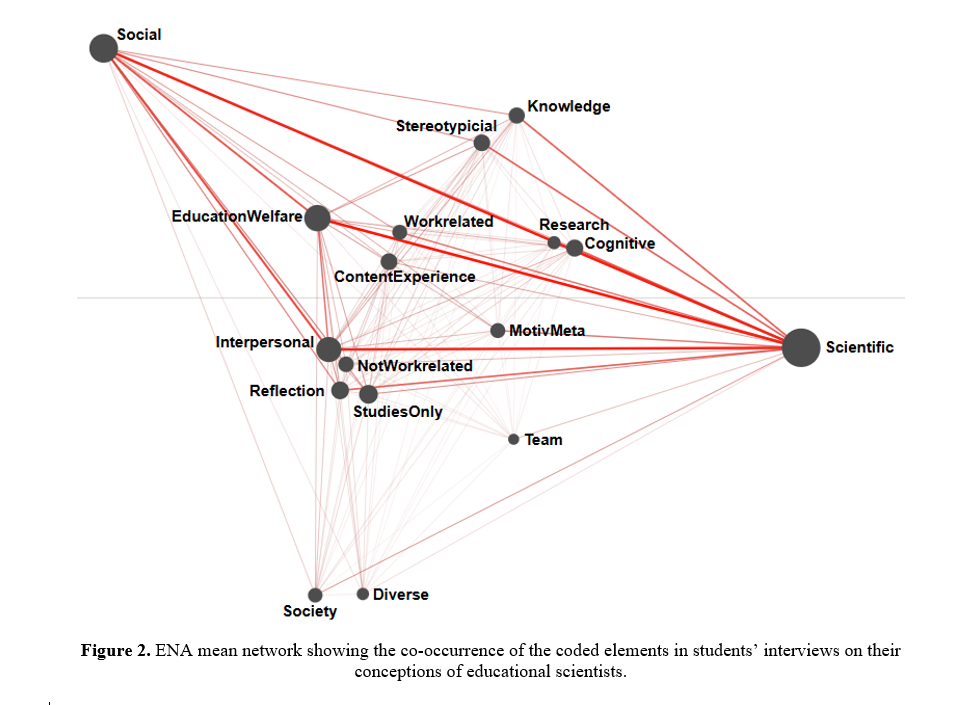
For readability and interpretability reasons, we excluded ten codes from the epistemic network analysis (ENA) that were used infrequently – specifically, those applied in fewer than 25 interviews and fewer than 45 statements. These codes represented marginal aspects within students’ conceptions of educational scientists and did not form strong or consistent connections to other codes within the network. Aspects that seem to play an important role in students’ perceptions relate to activities, skills, and working environment, as the nodes of these codes are significantly larger than the other codes in the network, meaning that they occurred most frequently. In addition, these codes co-occurred very often, as indicated by the thick connecting lines. According to this, students tend to think of educational scientists as people who carry out scientific and social activities in educational or welfare institutions and who need interpersonal skills in particular. Students also associate, albeit less strongly, scientific activities with knowledge development, stereotypical appearance, cognitive skills, work-related free time, and stimulation of reflection. Taken together, these results suggest that the predominant image that students have of educational scientists tends to refer to educational practitioners. However, although less dominant, students also imagine educational scientists as researchers, who are female, cognitively skilled, work in their free time, and contribute to knowledge and reflection. Thus, students appear to hold diverse and sometimes conflicting perceptions of educational scientists, viewing them both as teachers and social workers on one hand, and as scientific researchers on the other. This makes the following typological content analysis particularly relevant and insightful for understanding these varied perspectives more deeply.
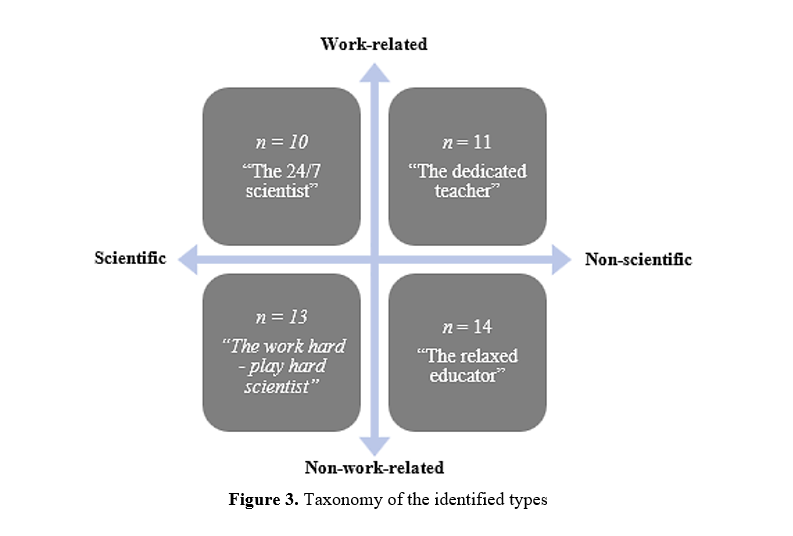
With regard to RQ2, the results of our typological content analysis show two major themes differentiating students’ conceptions of educational scientists. One focus of interest refers to the work life of educational scientists and the other to their private life. Within these two topics, the following characteristics appeared to be relevant: students described the work life of educational scientists either as a scientific profession (e.g. being a researcher in research institutions) or, in contrast, as any kind of social (i.e., non-scientific) occupation (e.g. working as a teacher or in kindergartens). Students imagined the private life of educational scientists as being either work-related, meaning that there is no strict separation of work and leisure time, or non-work-related, meaning that free time and work life do not overlap at all.
It should be noted that these characteristics were not mutually exclusive, meaning that students could have concurrent ideas about the work life of educational scientists, including both scientific and social activities, or concurrent ideas about their leisure time, being partly work-related and partly not. Therefore, the assignment of types adhered to the following four rules, which were developed iteratively by the raters: (1) Initial response: The student’s initial statements were prioritized. For example, if a student first mentioned scientific activities when describing the work of educational scientists, they were classified as belonging to the “scientific” type. (2) Frequency and exclusivity: Characteristics that were frequently mentioned or exclusively described were considered critical for classification (e.g., scientific activities were highlighted more often or to the exclusion of social activities). (3) Interviewer influence: The responses were assessed to ensure that the naming of characteristics was not influenced by the interviewer. (4) Explicitness: The characteristic had to be explicitly named and described by the student to be considered in the classification.
Against this background, the following taxonomy emerged (see also Figure 3): scientific/work-related, scientific/non-work-related, non-scientific/work-related, and non-scientific/non-work-related.
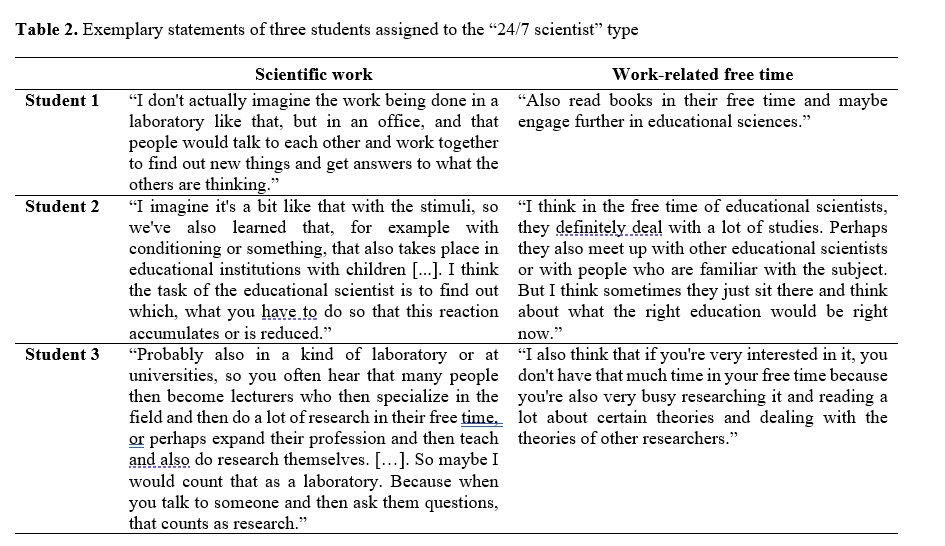
The 24/7 scientist: Defined by the absence of a strict separation between scientific work and private life, the “24/7 scientist” type describes learners’ conception of educational scientists as people whose professional pursuits seamlessly extend into leisure activities. Ten students were identified to hold this conception (see Table 2 for exemplary statements), according to which educational scientists predominantly work in universities or research institutions, focusing on scientific tasks such as conducting research, performing studies or experiments, evaluating findings, observing behavioral phenomena, reading academic texts, and publishing articles. Even in their free time, they are believed to engage in work-related activities, such as reading additional scientific materials or further developing their expertise in their research areas.
The examples in Table 2 not only illustrate the kinds of statements on which the assignment of the students’ descriptions to the "24/7 scientist" type are based, but also show that the students tend to have unspecific, diffuse, and uncertain ideas about the actual nature of the scientific work of educational scientists. Student 1 uses rather unspecific descriptions of the scientific tasks (“to find out new things” or “engage further in educational sciences”), student 2 refers to topics from instruction in school (“conditioning”), associates the work of educational scientists with the work in childcare centers, and thinks that they just sit around and think, while student 3 is uncertain whether the work of educational scientists can indeed be called research, whether the working environment can be called a laboratory, and whether research (instead of teaching or a private activity in one’s free time) can be the primary task of educational scientists.
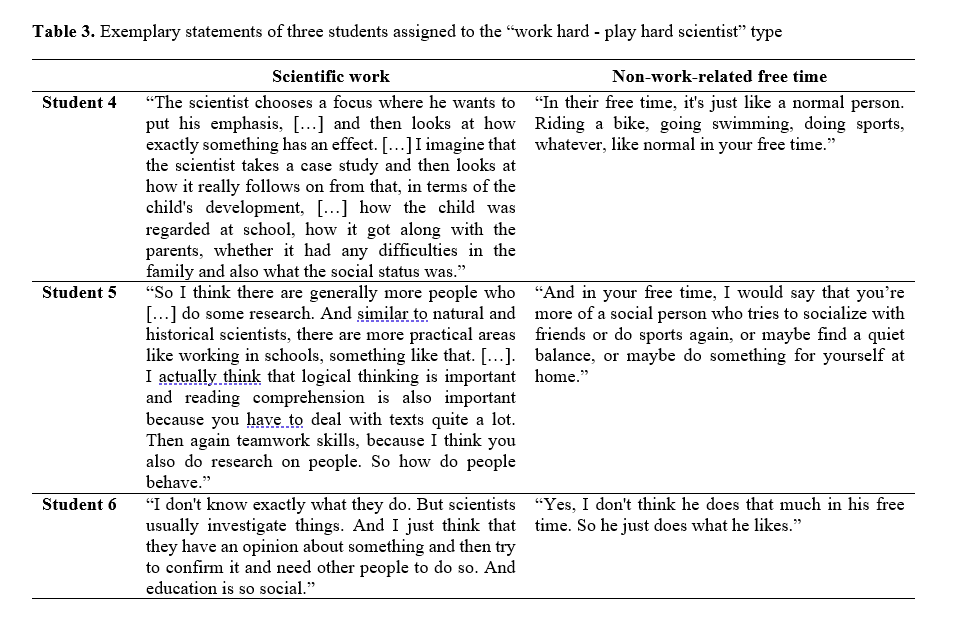
The work hard - play hard scientist: In contrast to the “24/7 scientist” type, the “work hard - play hard scientist” differs in the way they organize their leisure time. While work tasks are not different or at least similar to those of the first type, participants in the interviews about their conceptions of educational scientists indicated a stricter separation of work and leisure time. Hobbies that are not related to scientific work, such as meeting friends, sports or other activities, were mentioned. Based on the data, the conceptions of 13 participants were assigned to this type. Exemplary statements of these students are shown in Table 3.
Interestingly, while learners’ conceptions of this type associate educational scientists more with scientific work than with social work, they still emphasize the social nature of either educational scientists (see student 5’s description of leisure activities) or the field of education as a whole (see student 6’s statement that “education is so social”). Furthermore, student 4’s description of the scientific work of educational scientists seems to refer more to the work of a social worker or therapist than to that of a researcher.
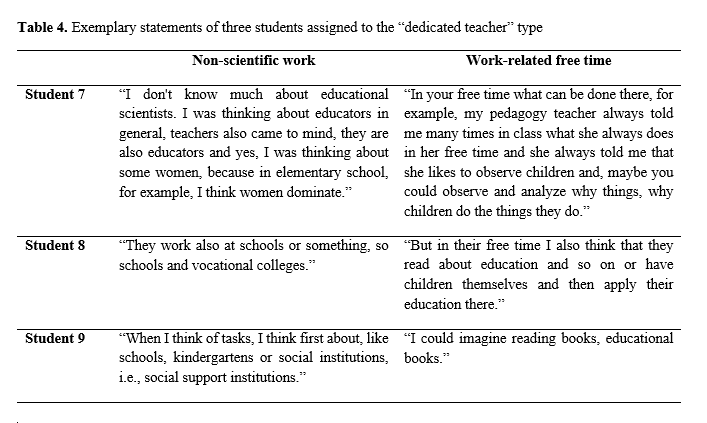
The dedicated teacher: A third category, the “dedicated teacher” type – reflected in the descriptions of educational scientists provided by 11 students (see Table 4 for exemplary statements) – is characterized by a social profile of work tasks. It is assumed that this type of educational scientist works as a teacher in schools, as a kindergarten teacher or in institutions that offer help to (young) people in need, such as welfare institutions. Their leisure time is likely to be related to their work tasks, such as reading professional literature, training in their field of work, or researching about the clients or people they work with. Specifically for teachers, it could be preparing lessons or correcting tests, and for kindergarten teachers it could be researching educational games or activities.
The examples in Table 4 illustrate that students’ conceptions of scientists can be strongly aligned with their experiences from school. Although explicitly asked how they conceptualize an educational scientist, student 7 thinks of their pedagogy teacher from school and refers to their teachers’ characteristics when describing the free time activities of educational scientists. Students 8 and 9 also think first of teachers rather than researchers when asked about their conceptions of educational scientists.
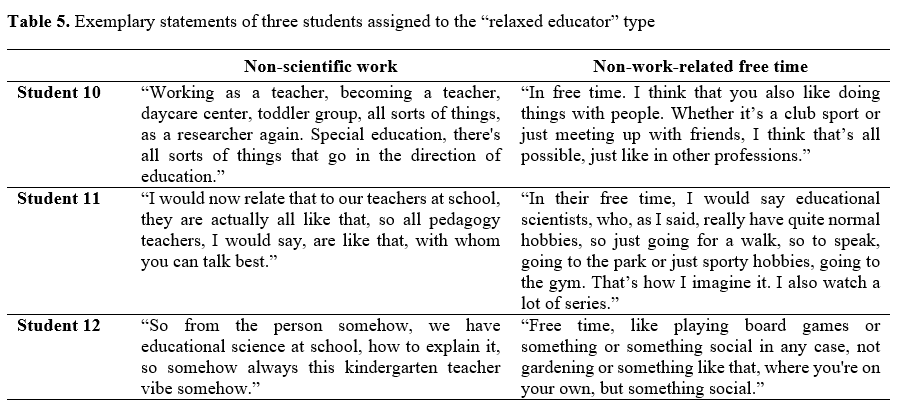
The relaxed educator: The conceptions of educational scientists elaborated by 14 participants fit the “relaxed educator” type, a group similar to the “dedicated teacher” in terms of working in schools, kindergartens, or social institutions. However, the “relaxed educator” differs significantly from the “dedicated teacher” in how they spend their leisure time, as their free time is notably less work-related. Participants mentioned engaging in hobbies like sports, meeting friends, or dining out. Thus, as a student said, “everybody does something different in their free time”. The most defining characteristic of this type is students’ idea that educational scientists strictly separate between work and personal life. One participant aptly put it as follows: “You have your regular work time and your regular free time”. For interview excerpts that illustrate the relaxed educator type in students’ descriptions, see Table 5.
The examples in Table 5 again illustrate that students are likely to think of their pedagogy teachers when imagining the work and characteristics of educational scientists (see student 11), and that students emphasize the social nature of educational scientists (or rather of educators) in their descriptions of their leisure activities (see students 10 and 12).
No type: Eleven interviews did not contain sufficient or explicit information regarding leisure time. It is important to note that all 11 students did reference the private life and leisure time of educational scientists during their interviews – either when prompted by the profile fact sheet or, if not mentioned spontaneously, when directly asked by the interviewer about their thoughts on the topic. However, their responses did not allow for a clear interpretation and, consequently, could not be assigned to any of the defined types. Four students stated that leisure time activities are unrelated to the profession or that educational scientists are free to engage in any activities during their free time, without providing further elaboration. Another four students commented vaguely that educational scientists probably also interact with people and children during their free time, without clarifying whether these interactions are professional in nature or not. One student offered a general statement that educational scientists should be able to separate work and private life, without specifying how this influences their leisure behavior. Another student admitted to having no idea what educational scientists do in their free time. As a result, these interviews were excluded from type categorization and not subjected to further analysis.
An additional five interviews could not be clearly categorized, either in terms of work characteristics or leisure time. These difficulties stemmed from the students’ unfamiliarity with the topic or their struggles to articulate their ideas (e.g., one participant stated: “I don't know. I don't have any imagination at all.” and “I don't know if I can say anything else about it.”), or statements lacked a discernible orientation toward one of the two defining characteristics necessary for type assignment. Regarding the working life category, one participant replied to the question about the tasks educational scientists perform with: “I think tasks like preparing and conducting studies, maybe also working with children”. In terms of the private life category, one student stated: “I think they do a lot of things in their free time that they like, that they enjoy or that make them happy. […] I can also imagine reading relatively well, just dealing with the job”. Due to this absence of clear direction or definable attributes, it was not possible to assign these students to any of the four types.
Relationship between typology and study interest: Adhering to the last step of typological content analysis, we explored the relationship between our typology and variables that were not used for classification. Building on the prevalent assumption of research on students’ images of scientists, we examined the relation of the different types of conceptions of educational scientists to students’ interest in studying educational sciences after graduation from high school . For this purpose, we conducted an ANOVA with two factors (i.e., factor 1: scientific vs. non-scientific; factor 2: work-related vs. non-work-related) and study interest as the dependent variable. The analysis revealed a statistically significant main effect of the factor work-relation on study interest, (F(1,46) = 6.65, p = .01, ηp² = .13), but no main effect of the factor scientific and no interaction effect. That is, students assigned to the two types referring to a strict separation of work and private life (i.e., the work hard - play hard scientist type and the relaxed educator type; n = 26) reported higher interest in studying educational sciences (M = 4.58; SD = 1.44) than students of the two types attributing work-related free time activities (M = 3.41; SD = 1.61) to educational scientists (i.e., the 24/7 scientist type and the dedicated teacher type; n = 21). Whether the work of educational scientists is more strongly associated with scientific than with social activities does not make a statistically significant, but only a descriptive difference for students’ study interest, favoring the two scientific types (scientific (n = 23): M = 4.29; SD = 1.52; non-scientific (n = 24): M = 3.83; SD = 1.70).
To get an even deeper understanding of students’ conceptions of educational scientists, we conducted two further exploratory analyses in which we investigated whether the conceptions differ between female and male students as well as between students who formally study educational science in school or not.
Gender differences
Regarding the typology, the descriptive statistics indicate notable gender differences. Female students’ conceptions of educational scientists were more frequently categorized under the two non-scientific types (42.2%) than the scientific types (31.6%). In contrast, male students’ conceptions were slightly more often classified under the scientific types (44%) than the non-scientific ones (36%).
To further investigate gender-based differences in conceptions of educational scientists, we conducted an Epistemic Network Analysis (ENA) based on codes derived from the qualitative content analysis. To minimize the risk of overfitting and ensure the validity of statistical comparisons, we limited the number of codes included in the ENA to 11, selecting those that contributed most prominently to any gender differences. For a sample of 60 students, the maximum allowable number of codes is 11 (calculated as N*(N-1)/2, where N is the number of codes and the result reflects the minimum sample size required, see Bowman et al., 2021). The ENA reveals significant differences in the conceptions of educational scientists between female (M = 0.06, SD = 0.21, n = 37) and male (M = -0.08, SD = 0.26, n = 26) students on the y-axis (t(46.53) = -2.19, p = 0.03, d = 0.58). These differences are visually represented in the difference graph in Figure 4. Female students formed stronger associations between codes located in the upper half of the diagram, such as Social, EducationWelfare, Stereotypical, and Workrelated. In contrast, male students exhibited their strongest connections in the lower half of the diagram, notably between Scientific, Society, and Reflection codes.
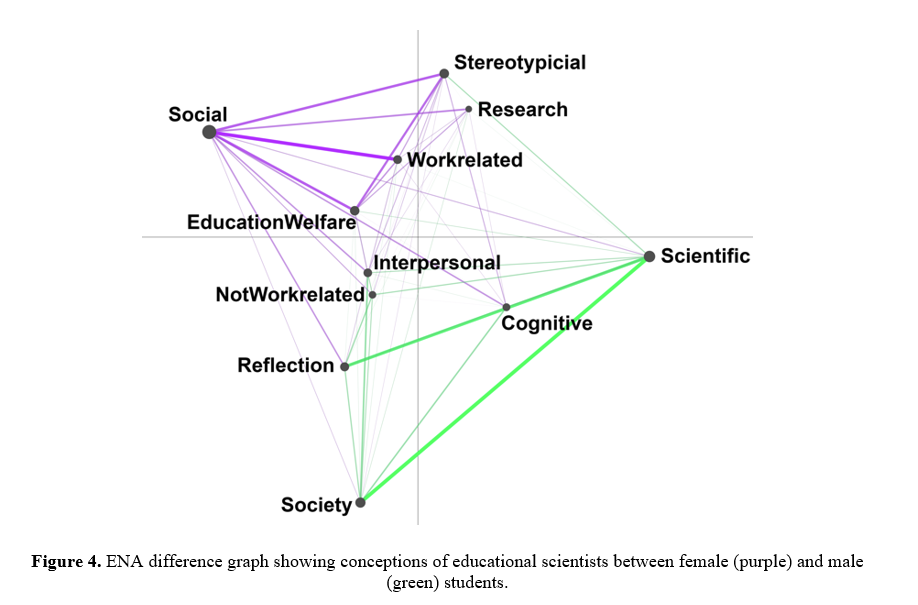
Thus, in both qualitative analyses, gender differences suggest that female students tend to perceive educational scientists more strongly as pedagogical professionals engaged in social activities – who, as indicated by the ENA results, are often female and dedicated. Conversely, male students are more inclined to associate their work with scientific pursuits that, according to the ENA, serve society and contribute to reflecting on implemented learning and education routines.
Differences in learning experiences
Most of our participants were school students who had chosen educational science as a subject. Four students visited the out-of-school lab with their psychology course. Among the eight students who visited the out-of-school lab as part of their biology courses, four stated that they had not selected educational science at school. This makes it especially interesting to qualitatively compare potential differences in conceptions of educational scientists across these three groups: the four students without educational science as a subject, the four psychology students, and those who study educational science in school.
For this purpose, we selected four educational science students who were comparable in terms of gender, age, school type, and grade level. The four biology course students were all in their final year at a Gymnasium; they were 17 years old, three male and one female. The four psychology course students were in the penultimate year at a Gymnasium; three were 17 years old, one was 16, with an even gender distribution (two male and two female). To ensure comparability, we selected the only two educational science students in our sample who were in their final year at a Gymnasium (one male and one female, aged 16 and 17, respectively), along with two additional 17-year-old students in their penultimate year (one male, one female).
Looking at the four interviews with biology course students, a striking diversity emerges in their conceptions of educational scientists. One student strongly associates them with therapists (“they set up experiments and then discuss them with the patients”), imagining that their work takes place in hospitals, medical practices, or online. As they interact with patients, they are seen as needing to be “good listeners” and “remain neutral”. Another student believes they know someone who studied educational science and now “works in a child and adolescent psychiatric clinic as a counselor”. Their conception is based on this association, seeing educational scientists as empathetic supervisors of children – and possibly parents – who “also have to do a bit of paperwork” in their “office job”. A third student holds a very negative image shaped by media and TV documentaries. Although their description of an educational scientist as someone working at a university or foundation developing models based on empirical observations of children is fairly accurate, they consider expert advice, such as on adolescent media use, to be unrealistic, because “what they say is usually complete garbage and doesn't really apply to the youth of today”. They also imagine educational scientists as “tree huggers […] who kind of come across like they’re a bit off”. The fourth student bases their ideas on school subjects, such as religion (where Freud was once discussed), and on classmates who study educational science and, notably, perform poorly in math. Nevertheless, this student holds a distinctly research-oriented view, describing educational scientists as people who conduct studies and surveys to develop theories and empirically investigate causal relationships in education (“you do research on people or through studies, surveys or polls […] and that you then put forward theories as to how something like that triggers this and for what reason, influences, what effects this then has, for example, mainly on education”).
All four psychology students hold a research-oriented view of the work of educational scientists to some extent, describing it as involving “a lot of research”. One student even names the various empirical methods that educational scientists may use: "There are observations and surveys, and you prepare and evaluate questionnaires and interpret the results. But also experiments, whether field or laboratory experiments.” A third student states that the aim of educational research is to “understand people or certain processes”, while the fourth specifies that educational scientists investigate “the factors that influence the development of children and young people”. This perspective is likely influenced by their experiences in their psychology course. Although they attempt to distinguish between educational science and psychology, these lenses often blur together in the descriptions of three students. One student explicitly notes that they do not study educational science at school and, at the beginning of the interview, asked whether the discussion was about educational science or also about psychology. Later, the student reflects: “I don't know, I hope I’m not forgetting some huge field. I don’t have educational science in class, I have psychology. […] There’s also this cliché in my head, which is sometimes associated with psychology, that some people try to treat themselves in a certain way.” Another student initially differentiates between the two fields but then merges them conceptually: “If it’s the pedagogues now, they’ll probably be concerned with how children are brought up, I think. The psychologists might rather try to understand what goes on in people’s heads. […] Specialist knowledge is a prerequisite in any case, as psychology or the humanities in general are something you can't just pick up at random.” A third student, who also selected educational science as a school subject, emphasizes similarities: “I also think a lot of it has to do with memorization and this, in conjunction. I also do pedagogy on the side and that’s a very good example: psychology and pedagogy. Educational science is that you have to be able to come up with a lot of new theories.”. The fourth student does not refer to their psychology class but still makes a school-based association: “Well, I only know them from our school, because of course we also have pedagogy teachers and the like, but I don’t think that it looks one-to-one like that in research, so teachers are something else again.”
Three of the four selected educational science students strongly associate the work of educational scientists with that of teachers (“When you think of educational science, you immediately think of the teaching profession, for example, that you work directly towards ensuring that students can learn”) and partially link the personal traits of educational scientists to those of their educational science teachers at school (“As a typical educational scientist, I somehow have my teacher in my head because I meanwhile associate him with it.”). Interestingly, although this teaching-focused perspective predominates, all students also mention that research could be a possible field of work for educational scientists, including conducting experiments or engaging with theories and studies (e.g., “If you do educational science as a scientist, so to speak, then it is..., you also do some studies”). That their conceptions are shaped by their own formal learning experiences is suggested by statements such as the following, which refers to typical tasks of educational scientists: “presenting or reciting the various theories. So that’s what I’ve mainly done in pedagogy so far”. Another example shows how students likely draw from classroom content when describing the relevance of the work of educational scientists: “When I think of Freud, for example, who set this up, with the ego, the id and the superego, that you simply see the connection as to why someone is perhaps now simply more aggressive”. It is also likely that the following comment on the work routine of educational scientists is based on personal school experiences: “I have the feeling, or at least the image, that it’s not such a strict subject”.
As this qualitative comparison illustrates, students conceptualize educational scientists differently depending on their formal study experiences. The four biology students draw on diverse sources, such as peers, media, and other school subjects, to shape their conceptions, which range from socially oriented to research-focused views of educational scientists. In contrast, the four psychology students appear to project their scientific understanding of psychology onto educational science, resulting in a perception that emphasizes scientific rigor. Meanwhile, the four educational science students closely associate their conception with their teachers and classroom experiences, viewing educational scientists primarily as teachers rather than researchers.
A large body of research has demonstrated that learners’ conceptions of (natural) scientists often tend to be diffuse, inaccurate, and stereotypical (e.g., Christidou 2011), and that such conceptions may influence their learning in school and career paths after school (e.g., Lin-Siegler et al., 2016; Miller et al., 2018). Thus, such findings point to the need to develop interventions that address learners’ inaccurate conceptions of scientists. In the present study, we addressed a critical and underexplored gap in learning research by investigating whether this need for interventions also applies to students’ conceptions of educational scientists. This seems relevant in view of previous studies demonstrating undervalued perceptions of educational science as a domain that is rarely associated with science, research, brilliance or competence (Gligorić et al., 2022; Leslie et al., 2015; Meyer et al., 2015; Heyder & Kortzak, 2024). Examining whether this view of the field of educational science extends to learners’ conceptions of educational scientists themselves appears important in light of research suggesting that learners base their academic choices on their images of professionals within a discipline (e.g., McPherson et al., 2018). In the present study, we therefore aimed to provide an in-depth exploration and description of learners’ conceptions of the work and personal characteristics of educational scientists based on data from semi-structured interviews. We conducted a qualitative content analysis to explore how learners think about various aspects of educational scientists that have been shown to determine students’ images of scientists in general (RQ1). In addition, we conducted a typological content analysis to gain more differentiated and deeper insights into learners’ conceptions of educational scientists (RQ2). In two further exploratory analyses, we investigated students’ gender and their formal study experiences as two potential factors influencing students’ conceptions of educational scientists.
With regard to RQ1, the results of the qualitative content analysis and the ENA show that learners associate the work of educational scientists with both scientific and social tasks. These tasks are typically carried out in educational or social institutions rather than in research settings and require mainly interpersonal rather than cognitive skills. Their work is perceived as relaxed, contributing to knowledge and reflection through good educational practice and support for families and children. The motivation to become an educational scientist is often driven by personal interest or community-oriented motives (i.e., helping others). Learners also tend to imagine educational scientists as women who engage in work-related leisure activities such as observing people’s behavior and reading educational books, or in social, non-work-related activities involving interaction with others.
This learners’ view of educational scientists is consistent with the general view of educational science as a discipline and probably of social sciences in general. Overall, our findings suggest that learners associate educational scientists less with research and science and more with pedagogical and socially oriented professions of teachers or social workers, which is consistent with research showing that social sciences are rarely associated with research (Ziegler et al., 2018) or scientific professions (Gligorić et al., 2022). Learners’ emphasis on interpersonal rather than cognitive skills required for the work of educational scientists is literally consistent with the view of educational science as a soft science and with studies showing that the field of educational science is more strongly associated with aspects of warmth (Heyder & Kortzack, 2024) than with competence or brilliance (Leslie et al., 2015; Meyer et al., 2015).
The way in which students conceptualize the work and personal characteristics of educational scientists is almost detrimental to the way in which they typically imagine and describe scientists in general. As numerous studies have shown, students typically imagine scientists not as women, but as older male Caucasians wearing lab coats and glasses (e.g., Miller et al., 2018; Ferguson & Lezotte, 2020). These men are seen as highly intelligent, brilliant, and dedicated but often socially isolated (e.g., Finson, 2002; Christidou, 2011), which is in stark contrast to the skills attributed to educational scientists. In addition, students think of scientists as researchers who primarily work in laboratories conducting experiments (e.g., Boylan et al., 1992; Wentorf et al., 2015), and thus less as practitioners who engage in social and community-oriented activities in educational or welfare settings. Students believe that scientists undergo long and hard training and see their work as contributing significantly to innovations that improve human life (Mead & Métraux, 1957). This view is at contrast with what learners in our study said about educational scientists who only need to get a degree and then primarily help other people with their work, rather than contribute to novel developments.
With respect to RQ2, the results of our typological content analysis revealed a differentiation in learners’ conceptions of educational scientists based on the imagined actual nature of the work described as either more scientifically dedicated or more socially oriented. Another unexpected aspect that played a role in the differentiation of types in learners’ conceptions concerned their ideas about how educational scientists spent their leisure time. That is, whether or not they engaged in work-related activities. Based on these two dimensions, we classified learners' conceptions of educational scientists into four types: the 24/7 scientist, the work hard-play hard scientist, the dedicated teacher, and the relaxed educator.
Already one of the defining characteristics of this typology, the scientific vs. non-scientific dimension, points to a critical gap in the way how educational scientists are understood, namely as researchers. Even the conceptions assigned to the two types of scientists suggest that learners tend to have diffuse and uncertain ideas about the actual scientific endeavors of educational scientists, whether these can actually be characterized as research, and whether this can be the core of their work. In addition, conceptions of learners assigned to the two scientist types still emphasize the social nature of the field or the people who work in the field.
This finding likely speaks for a discipline-specific phenomenon, which becomes particularly evident in comparison to the typologies that have been identified in research on learners’ images of (natural) scientists. In these typologies the scientific character of the work of natural scientists is not questioned, instead learners vary in the extent to which they attribute scientists a particular high level of intelligence and intellectuality or a certain level of craziness and risk-taking (see Chambers, 1983; Solomon, 1993; Brumovska et al., 2022). Learners’ prevalent perception of the work of educational scientists as more socially oriented and rather non-scientific and ideas such as that educational scientists “just sit there and think” (see student 2’s statement shown in Table 2) match the image of educational science as a “babbling subject” at school " [translated from German, see Baumgart & Bubenzer, 2001]. Thus, it is likely that learners build their conceptions of the work of educational scientists based on the experiences in school, what Schoenfeld (1988) similarly claimed for students’ views of mathematics and Larochelle and Désautels (1991) for students’ ideas of scientific knowledge. This claim is further supported by the findings of the present study showing that students may refer in their descriptions of educational scientists either to topics from their educational science class at school (see student 2) or to the work and characteristics of their pedagogy teachers (see students 7 and 11).
In contrast to the scientific vs. non-scientific dimension of the typology, the dimension of work-related vs. non-work-related free time seems to indicate a generation-specific rather than a discipline-specific phenomenon. This is particularly suggested by the relationship we found between students’ perceptions of the leisure activities of educational scientists and their interest in studying educational science after high school. Specifically, students whose descriptions were classified as belonging to the two types of educational scientists who are thought to maintain a strict separation between work and leisure time and to engage in normal hobbies reported a significantly higher interest in studying educational science than students who believe that educational scientists also engage in work-related activities in their leisure time. This finding could be due to a Gen Z effect, because “among all generations, Gen Z is the generation that most values the application of work-life balance and puts less emphasis on work in their lives.” (Waworunto et al., 2022, p. 392).
It is important to note that many participant responses were vague, non-specific, or even contradictory. This ambiguity is a central finding of the typological content analysis and of the present study. It reflects students’ lack of familiarity and conceptual clarity regarding the role of educational scientists. This finding highlights the need for more targeted efforts to enhance students’ understanding of educational research and researchers.
In our exploratory analyses, we identified differences in learners’ conceptions of educational scientists based on both students’ gender and their formal study experience.
With respect to gender differences, our findings suggest that female students are more likely to perceive educational scientists as dedicated, pedagogical – predominantly female – professionals who are engaged in socially-oriented activities. In contrast, male students tend to associate educational scientists more strongly with scientific work that contributes to societal development and fosters reflection on educational practices and routines. At first glance, this pattern appears consistent with previous research on children’s drawings of scientists, which found that boys are more likely than girls to depict scientists as male – an outcome thought to reflect children’s positive identification with their own gender, mirrored in their drawings (Miller et al., 2018). However, as children grow older, girls also increasingly draw male rather than female scientists (Miller et al., 2018), suggesting that positive attitudes toward one’s own gender may not fully explain the gendered differences observed in our study. Nevertheless, our results indicate that learners reproduce social gender norms in their conceptions of educational scientists. Female students’ portrayals of educational scientists as caring, socially engaged, and self-sacrificing professionals align with broader gender norms that associate women with nurturing and communal behaviors (Ellemers, 2018) – norms that female students may have internalized. This tendency is well illustrated by the following statement from one of the female participants in our study:
“They have a lot more to do with children, also because as a woman you carry the children yourself and then give birth to them and are always there for them in the first few years. As a result, children may also have a stronger bond with their mother, and so the mother has to adjust to bringing up a child like that. And yes, I have the feeling that more women do it because they feel closer to it.”
In contrast, male students’ perceptions of educational scientists as influential researchers contributing to society resonate with social expectations that align masculinity with agentic traits, such as performance and assertiveness (Ellemers, 2018). Their association of educational science with research-driven work further reflects traditionally masculine-coded conceptions of scientific roles (see e.g., Miller et al., 2018).
In addition to learners’ gender and the internalized social norms that – according to our findings – may shape their conceptions of educational scientists, another influential factor appears to be their formal study experience. This pattern aligns with previous research suggesting that learning experiences in school influence learners’ conceptions of science or certain subjects (see Schoenfeld, 1988; Larochelle & Désautels, 1991). Specifically, our qualitative comparison suggests that school-based instruction in educational science tends to foster a more socially oriented and less research-focused view of the profession. This stands in notable contrast to psychology students, who seem to hold a strongly research-oriented understanding of psychology, which they then extend to their perceptions of educational scientists. In cases where students have no formal academic background in either educational science or closely related fields such as psychology, their conceptions of educational scientists appear more diverse but generally less related to scientific roles. In some instances, these perceptions are even partly negative, often shaped by secondhand sources such as media portrayals, peers, or experiences in other (unrelated) subjects.
These findings highlight the complex interplay between gender, social norms, and formal educational experiences in shaping how learners conceptualize educational scientists. These insights point to the importance of making the diverse roles and contributions of educational scientists more visible – particularly their scientific expertise – in order to broaden and balance student perceptions across different groups. Moreover, educational science instruction might benefit from adopting certain elements from psychology education, which appears to place stronger emphasis on empirical approaches and scientific methods, in order to promote a more research-oriented view of the field. This could help to convey educational scientists as both socially engaged and scientifically grounded professionals.
The results of the present interview study clearly show that students do not primarily view educational scientists as cognitively skilled researchers who engage in scientific endeavors at research institutions. Not only does the prevailing image among the majority of students refer more to educational practitioners who need strong interpersonal skills to help children and families in educational and social service settings (see RQ1), but those students who do associate educational scientists with research activities tend to have unspecific, diffuse, and uncertain ideas about the actual nature of this work (see RQ2). This lack of understanding relates to a very general awareness of the fact that educational scientists engage in scientific inquiry to gain new knowledge and that, according to the official occupational classification of the German Federal Employment Agency (Bundesagentur für Arbeit) (2020), they “research educational contexts and use the findings to develop proposals on how educational practice can be designed or improved” [translated from German]. Such a lack of awareness among learners may affect (1) their learning of educational and social science subjects at school, as well as (2) their interest in and expectations of studying these disciplines after graduation.
As shown in the studies by Hong and Lin-Siegler (2012) and Lin-Siegler et al. (2016) for learning science in school, learners’ conceptions of scientists can affect their motivation to learn and their performance in class. Not only are similar effects likely to occur in the learning of educational and social science subjects in school, but learners’ lack of awareness of the scientific nature of the work of educational scientists, which we have also found in relation to their perceptions of social scientists in general (see Nachtigall & Rummel, 2020), may hinder the effectiveness of learning environments that aim to foster students’ interest in and knowledge of scientific ways of thinking and working in the social sciences and humanities (see Nachtigall & Rummel, 2021). It is likely to assume that learners’ conceptions of the work of educational scientists also affect their epistemic beliefs about the nature of knowledge within the educational sciences. Specifically, students with less or non-scientific images of educational scientists may evaluate knowledge in this field as being less variable and tentative than learners holding a scientific image of educational scientists. Learners’ epistemic beliefs have been shown to be related to their learning and motivation (Bråten et al., 2011; Chen & Barger, 2016; Guo et al., 2022). Thus, investigating the potential relationship between students’ conceptions of scientists on the one hand and their epistemic beliefs about the nature of knowledge on the other hand constitutes an interesting and important avenue for future research.
Beyond their learning in school, learners’ conceptions of educational and social scientists may also influence their expectations of and interest in studying these disciplines after graduation. Previous research on learners’ images of scientists has often argued that inaccurate and stereotypical conceptions of natural scientists may discourage certain students (particularly female students or students who believe they are not smart enough) from pursuing STEM careers (e.g., Miller et al., 2018; McPherson et al., 2018). With regard to the social sciences and humanities, inaccurate conceptions of scientists within these disciplines appear to result in an even increased interest of students in studying the social sciences (see Nachtigall & Rummel, 2020), which aligns with Pauly’s claim that the social sciences and humanities are studied by “the wrong people for the wrong reasons” [Translated from German, see Pauly, 2012, p. 209]. Specifically, learners’ lack of awareness of the scientific nature of the work of educational and social scientists and their attribution of more social and interpersonal than cognitive abilities may lead them to have false expectations about their studies and, ultimately, to have disappointing experiences in educational and social science programs at universities that are, in fact, scientifically oriented and cognitively demanding. This could help explain why, at least in Germany, the social sciences – and educational sciences in particular – have seen a significant decrease in students pursuing a master’s degree after completing their bachelor’s studies (Kerst & Wolter, 2020). As master’s programs in educational sciences often include a greater focus on research-oriented components compared to bachelor’s programs (Grunert et al., 2020), students are increasingly opting against continuing with a more research-intensive degree.
Although the interviews we conducted did not explicitly address the origins of students’ conceptions of educational scientists, the results of this study suggest that inaccurate ideas are likely rooted in learners’ school experiences and internalized social norms. Another influential source appears to be portrayal in films, which often tend to convey the image of a mad and male natural scientist (see Pansegrau, 2009). Thus, learners’ (mis)conceptions seem to have cultural origins, perpetuated partly by teachers – who may themselves hold and transmit these views (see Hagenkötter et al., 2022) – and partly through media representations. The prevalent, narrow association of scientific work with the natural sciences, may have broader societal and political consequences. For example, educational policy decisions may be made without sufficient consideration of research and evidence produced by educational scientists. The fact that the field of educational science is not widely recognized as a research domain (see e.g., Ziegler et al., 2018; Gligorić et al., 2022) may help explain why its insights have long been overlooked in evidence-informed decision-making in education policy, practice, and public discourse (see Oakes, 2018). Consequently, there is a pressing need for targeted interventions that foster more accurate understandings of the scientific work conducted by educational and social scientists, among learners, teachers, and the broader public. Future research should focus on designing and evaluating such interventions, while also explicitly examining the sociocultural origins of students’ conceptions, including school experiences and media influences. This would deepen our understanding of how learners perceive educational scientists, an endeavor to which the present study has already made a valuable contribution.
Taken together, this study makes a novel contribution to learning research by shifting the focus beyond learners’ conceptions of natural scientists to those of educational scientists, a domain that has not been traditionally explored. The present findings highlight the importance of examining these conceptions and pave the way for further research to investigate how perceptions of scientists in various social science domains are formed and how they relate to learners’ academic achievement, epistemic beliefs, motivation, and career choices. Further research is also needed to examine whether the findings of the present study can be replicated with learners of different ages and cultural backgrounds. We focused on secondary school students from grade 10 onward, as these students typically begin to form more concrete ideas about their future careers. However, it remains an open question when learners begin to develop non-scientific conceptions of educational and social scientists. It is also possible that the conceptions identified in this study are influenced by the specific cultural context of the participants. While existing research suggests that students’ images of (natural) scientists are relatively consistent across age groups and cultures (see Finson, 2002; Christidou, 2011; Miller et al., 2018), this may not hold for disciplines like educational science. In countries where educational science is not offered as a school subject, students may form conceptions of educational scientists without direct exposure to the field. Future research could investigate how learners in such contexts conceptualize the role of educational scientists, and whether the absence of subject-based familiarity leads to different forms of professional imagery, as already partly suggested by our exploratory analysis.
The following potential limitations of the present study should be taken into account when interpreting the findings. (1) Although the sample size of the present study is relatively large for a qualitative research study, N = 64 is not a sufficient size to make any generalizable claims. As the purpose of this study was to gain deep insights into learners’ conceptions of scientists beyond the natural sciences, a qualitative approach that captures students’ differentiated ideas was necessary. It is worth noting, however, that the findings are consistent with those of a previous survey study in which we assessed students’ conceptions of scientists within the social sciences and humanities in a larger sample of 149 students (Nachtigall & Rummel, 2020). Furthermore, the findings align with those of our pilot study, in which we explored learners’ conceptions of educational scientists using a survey with open-ended questions (Nachtigall et al., 2021). The interview results presented here are currently informing the development and validation of a standardized questionnaire designed to assess students’ conceptions of educational scientists. This tool will facilitate the replication of the present findings in studies involving larger sample sizes.
(2) The fact that 16 interviews could not be assigned to one of the four types may be interpreted as a limitation of the interview design. As noted above, we did not initially anticipate that students’ conceptions of leisure time would play such a central role in the development of our typology. While our interview protocol included systematically designed follow-up questions to specify, deepen, and contextualize students’ responses – drawing on the approach of Merton et al. (1990) – we applied these questions flexibly and situationally. This was done intentionally to avoid what Przyborski and Wohlrab-Sahr (2021) refer to as “guideline bureaucracy” and to create space for students’ spontaneous input and intuitive conceptions. That some students nevertheless struggled to articulate clear or differentiated views on certain aspects does not indicate a flaw in the interview design per se but rather underscores the inherent challenge of eliciting abstract or less salient perceptions in interviews with young participants. This highlights an area for potential refinement in future research, for example, by offering more scaffolding to better support students in expressing their views.
(3) Using follow-up questions flexibly and in situ during the interview process may raise questions about potential interviewer bias affecting our results. To minimize potential interviewer bias, all interviews were conducted using a semi-structured format based on a standardized interview protocol and accompanied by a profile fact sheet used as stimulus material. This structure ensured consistency in the formulation and sequencing of questions, including during follow-up probes, while still allowing for the flexibility required in qualitative interviewing. The majority of the interviews were conducted by the first author. However, four interviews were conducted by a trained student research assistant. These interviews were successfully assigned to two of the most frequently occurring types during typological content analysis, suggesting that the results were comparable across interviewers and not significantly shaped by individual interviewer behavior. Moreover, the findings from this interview study replicate results from two previous survey studies we conducted and align with broader research on perceptions of educational science as a domain. These similarities further support the robustness of the findings and suggest that systematic interviewer bias is unlikely to have significantly impacted the results.
The research presented in this paper was funded by the German Research Foundation (DFG, Project Number: 497500402). We would like to express our sincere gratitude to our student research assistants, Ferida Braham, Elias Brechmann, Nina Ehrhardt, Eeske Hahn, and Nina Hansberg for their invaluable help in collecting, preparing, and coding the data for this study. We would also like to thank the students who took part in the study, as well as their teachers and the Alfried Krupp-Schülerlabor [out-of-school laboratory] at Ruhr University Bochum that made data collection possible.
https://doi.org/10.25656/01:4289
Berliner, D. C. (2002). Comment: Educational research: The hardest science
of all. Educational researcher, 31(8), 18-20.
https://doi.org/10.3102/0013189X031008018
Bowman, D., Swiecki, Z., Cai, Z., Wang, Y., Eagan, B., Linderoth, J., &
Shaffer, D. W. (2021). The mathematical foundations of epistemic network
analysis. In A.R. Ruis & S. B. Lee (Eds.).
Advances in Quantitative Ethnography: Second International Conference,
ICQE 2020, Malibu, CA, USA, February 1-3, 2021, Proceedings 2
(pp. 91-105). Springer International Publishing.
https://doi.org/10.1007/978-3-030-67788-6_7
Boylan, C. R., Hill, D. M., Wallace, A. R., & Wheeler, A. E. (1992).
Beyond stereotypes. Science Education, 76(5), 465-476.
https://doi.org/10.1002/sce.3730760502
Bråten, I., Britt, M. A., Strømsø, H. I., & Rouet, J. F. (2011). The
role of epistemic beliefs in the comprehension of multiple expository texts:
Toward an integrated model. Educational Psychologist, 46(1), 48-70.
https://doi.org/10.1080/00461520.2011.538647
Brown, E. R., Thoman, D. B., Smith, J. L., & Diekman, A. B. (2015).
Closing the communal gap: The importance of communal affordances in science
career motivation. Journal of applied social psychology,
45
(12), 662-673.
https://doi.org/10.1111/jasp.12327
Brumovska, T. J., Carroll, S., Javornicky, M., & Grenon, M. (2022).
Brainy, Crazy, Supernatural, Clumsy and Normal: Five profiles of children's
stereotypical and non-stereotypical perceptions of scientists in the
Draw-A-Scientist-Test.
International Journal of Educational Research Open
, 3, 100180.
https://doi.org/10.1016/j.ijedro.2022.100180
Burkhardt, H., & Schoenfeld, A. H. (2003). Improving educational
research: Toward a more useful, more influential, and better-funded
enterprise. Educational researcher, 32(9), 3-14.
https://doi.org/10.3102/0013189X032009003
Campbell, J. L., Quincy, C., Osserman, J., & Pedersen, O. K. (2013).
Coding in-depth semistructured interviews: Problems of unitization and
intercoder reliability and agreement.
Sociological methods & research, 42
(3), 294-320.
https://doi.org/10.1177/0049124113500475
Chambers, D. W. (1983). Stereotypic images of the scientist: The
Draw‐a‐Scientist Test. Science education, 67(2), 255-265.
https://doi.org/10.1002/sce.3730670213
Chen, J. A., & Barger, M. M. (2016). Epistemic cognition and motivation.
In J. A. Greene, W. A. Sandoval, & I. Bråten (Eds.)
Handbook of epistemic cognition
(pp. 425-438). Routledge.
Cheryan, S., Plaut, V. C., Handron, C. & Hudson, L. (2013). The
stereotypical computer scientist: Gendered media representations as a
barrier to inclusion for women. Sex roles, 69(1-2), 58-71.
https://doi.org/10.1007/s11199-013-0296-x
Chi, M. T. (1997). Quantifying qualitative analyses of verbal data: A
practical guide. The journal of the learning sciences,
6(3), 271-315.
https://doi.org/10.1207/s15327809jls0603_1
Christidou, V. (2011). Interest, Attitudes and Images Related to Science:
Combining Students' Voices with the Voices of School Science, Teachers, and
Popular Science.
International Journal of Environmental and Science Education
, 6(2), 141-159.
Christidou, V., Bonoti, F., & Hatzinikita, V. (2023). Drawing a
scientist: using the Emo-DAST to explore emotional aspects of children’s
images of scientists.
Research in Science & Technological Education
, 41(4), 1287-1308.
https://doi.org/10.1080/02635143.2021.1998770
Cundiff, J. L., Vescio, T. K., Loken, E. & Lo, L. (2013). Do
gender–science stereotypes predict science identification and science career
aspirations among undergraduate science majors?.
Social Psychology of Education
, 16(4), 541-554.
https://doi.org/10.1007/s11218-013-9232-8
Diekman, A. B., Brown, E. R., Johnston, A. M., & Clark, E. K. (2010).
Seeking congruity between goals and roles: A new look at why women opt out
of science, technology, engineering, and mathematics careers.
Psychological science
, 21(8), 1051-1057.
https://doi.org/10.1177/0956797610377342
Ellemers, N. (2018). Gender stereotypes.
Annual review of psychology
, 69(1), 275-298.
https://doi.org/10.1146/annurev-psych-122216-011719
Federal Employment Agency Germany (2020).
Klassifikation der Berufe 2010 – überarbeitete Fassung 2020 - Berufe in
der Erziehungswissenschaft (9133)
[Classification of professions 2010 – Revised version 2020- Professions in
educational research (9133)].
Ferguson, S. L., & Lezotte, S. M. (2020). Exploring the state of science
stereotypes: Systematic review and meta‐analysis of the Draw‐A‐Scientist
Checklist. School science and mathematics, 120(1), 55-65.
https://doi.org/10.1111/ssm.12382
Finson, K. D. (2002). Drawing a scientist: What we do and do not know after
fifty years of drawings. School science and mathematics, 102(7),
335-345.
https://doi.org/10.1111/j.1949-8594.2002.tb18217.x
Finson, K. D. (2003). Applicability of the DAST-C to the images of
scientists drawn by students of different racial groups.
Journal of Elementary Science Education
, 15(1), 15-26.
https://doi.org/10.1007/BF03174741
Finson, K. D., Beaver, J. B., & Cramond, B. L. (1995). Development and
field test of a checklist for the Draw‐A‐Scientist Test.
School science and mathematics
, 95(4), 195-205.
https://doi.org/10.1111/j.1949-8594.1995.tb15762.x
Gligorić, V., van Kleef, G. A., & Rutjens, B. T. (2022). Social
evaluations of scientific occupations. Scientific Reports, 12(1),
18339.
https://doi.org/10.1038/s41598-022-23197-7
Grunert, C., Ludwig, K. & Hüfner, K. (2020). Studiengänge und Standorte
im Hauptfach. In H. J. Abs, H. Kuper & R. Martini (Eds.),
Datenreport Erziehungswissenschaft 2020
(pp. 21-50). Opladen: Verlag Barbara Budrich.
https://doi.org/10.25656/01:18988
Guilfoyle, L., McCormack, O., & Erduran, S. (2020). The "tipping point"
for educational research: The role of pre-service science teachers’
epistemic beliefs in evaluating the professional utility of educational
research. Teaching and Teacher Education, 90, 103033.
https://doi.org/10.1016/j.tate.2020.103033
Guo, J., Hu, X., Marsh, H. W., & Pekrun, R. (2022). Relations of
epistemic beliefs with motivation, achievement, and aspirations in science:
Generalizability across 72 societies.
Journal of Educational Psychology, 114
(4), 734-751.
https://doi.org/10.1037/edu0000660
Hagenkötter, R., Nachtigall, V., Rolka, K., & Rummel, N. (2022).
Exploring students’ and mathematics teachers’ conceptions about the work of
mathematical scientists and possible relations to mathematics teaching. In
C. Chinn, E. Tan, C. Chan & Y. Kali (Eds.),
International collaboration toward educational innovation for all:
overarching research, development, and practices,
Proceedings of the 16th International Conference of the Learning
Sciences-ICLS 2022
(pp. 155-162). International Society of the Learning Sciences.
https://repository.isls.org//handle/1/8537
Heyder, A., & Kortzak, O. (2024). Backlash against women and support for
men? On the perception of men and women researchers in gender
stereotype-inconsistent domains. Psychology of Women Quarterly,
48(3), 411-429.
https://doi.org/10.1177/03616843241236397
Hong, H. Y. & Lin-Siegler, X. (2012). How learning about scientists'
struggles influences students' interest and learning in physics.
Journal of educational psychology, 104
(2), 469-485.
https://doi.org/10.1037/a0026224
Höttecke, D. (2001). Die Vorstellungen von Schülerinnen und Schülern von der
“Natur der Naturwissenschaften” [Students’ conceptions of the “nature of
science”]. Zeitschrift für Didaktik der Naturwissenschaften 7,
7–23.
https://doi.org/10.25656/01:31535
Kaestle, C. F. (1993). Research news and comment: The awful reputation of
education research. Educational Researcher, 22(1), 23-31.
https://doi.org/10.3102/0013189X022001023
Kerst, C., & Wolter, A. (2020). Studienabschlüsse, Übergänge und
beruflicher Verbleib der Absolventinnen und Absolventen [Degrees,
transitions, and career paths of graduates]. In H. J. Abs, H. Kuper & R.
Martini (Eds.), Datenreport Erziehungswissenschaft 2020 (pp.
79-113). Opladen: Verlag Barbara Budrich.
https://doi.org/10.25656/01:18990
Krajkovich, J. G. & Smith, J. K. (1982). The development of the image of
science and scientists scale.
Journal of Research in Science Teaching
, 19(1), 39-44.
https://doi.org/10.1002/tea.3660190106
Kuckartz, U. & Rädiker, S. (2022).
Qualitative Inhaltsanalyse. Methoden, Praxis, Computerunterstützung
(5. Aufl.). Beltz Juventa.
Landis, J. R., & Koch, G. G. (1977). The measurement of observer
agreement for categorical data. biometrics, 159-174.
https://doi.org/10.2307/2529310
Lane, K. A., Goh, J. X. & Driver-Linn, E. (2012). Implicit science
stereotypes mediate the relationship between gender and academic
participation. Sex Roles, 66(3-4), 220-234.
https://doi.org/10.1007/s11199-011-0036-z
Larochelle, M., & Désautels, J. (1991). ‘Of course, it's just obvious’:
adolescents’ ideas of scientific knowledge.
International journal of science education, 13
(4), 373-389.
https://doi.org/10.1080/0950069910130402
Leslie, S.-J., Cimpian, A., Meyer, M., & Freeland, E. (2015).
Expectations of brilliance underlie gender distributions across academic
disciplines. Science, 347(6219), 262–265.
https://doi.org/10.1126/science.1261375
Light, A. E., Benson-Greenwald, T. M., & Diekman, A. B. (2022). Gender
representation cues labels of hard and soft sciences.
Journal of Experimental Social Psychology
, 98, 104234.
https://doi.org/10.1016/j.jesp.2021.104234
Lin-Siegler, X., Ahn, J. N., Chen, J., Fang, F. F. A. & Luna-Lucero, M.
(2016). Even Einstein struggled: Effects of learning about great scientists’
struggles on high school students’ motivation to learn science.
Journal of Educational Psychology, 108
(3), 314-328.
https://doi.org/10.1037/edu0000092
Mayring, P. (2014).
Qualitative content analysis: theoretical foundation, basic procedures
and software solution.
Klagenfurt.
https://nbn-resolving.org/urn:nbn:de:0168-ssoar-395173
McPherson, E., Park, B., & Ito, T. A. (2018). The role of prototype
matching in science pursuits: Perceptions of scientists that are inaccurate
and diverge from self-perceptions predict reduced interest in a science
career. Personality and Social Psychology Bulletin, 44(6), 881-898.
https://doi.org/10.1177/0146167217754069
Mead, M., & Metraux, R. (1957). Image of the scientist among high-school
students: A pilot study. Science, 126(3270), 384-390.
https://doi.org/10.1126/science.126.3270.384
Merk, S., Rosman, T., Rueß, J., Syring, M., & Schneider, J. (2017).
Pre-service teachers’ perceived value of general pedagogical knowledge for
practice: Relations with epistemic beliefs and source beliefs.
PloS one
, 12(9), e0184971.
https://doi.org/10.1371/journal.pone.0184971
Merton, R.K., Fiske, M., & Kendall, P.L. (1990)
The focused interview. A manual of problems and procedures.
2nd Edition, Free Press, New York.
Meyer, M., Cimpian, A., & Leslie, S-J (2015). Women are underrepresented
in fields where success is believed to require brilliance.
Frontiers in Psychology
, 6, Article 235.
https://doi.org/10.3389/fpsyg.2015.00235
Miller, D. I., Nolla, K. M., Eagly, A. H., & Uttal, D. H. (2018). The
development of children's gender‐science stereotypes: A meta‐analysis of 5
decades of US Draw‐a‐Scientist studies. Child development,
89
(6), 1943-1955.
https://doi.org/10.1111/cdev.13039
Nachtigall, V., Nößler, A., & Sung, H. (2021). An Epistemic Network
Analysis of Students’ Beliefs About Natural and Educational Scientists. In
B. Wasson & S. Zörgő (Hrsg.),
Advances in Quantitative Ethnography
(pp. 207–220). Springer International Publishing.
https://doi.org/10.1007/978-3-030-93859-8_14
Nachtigall, V., & Rummel, N. (2020). “Social Scientists Need to Be Nice
and Empathetic”: Exploring Students’ Beliefs Related to Social Sciences and
Humanities. In M. Gresalfi & I. Seidel Horn (Eds.),
The Interdisciplinarity of the Learning Sciences, Proceedings of the
14th International Conference of the Learning Sciences (ICLS) 2020
, Volume 1 (pp. 641-644). International Society of the Learning Sciences.
https://repository.isls.org//handle/1/6716
Nachtigall, V., & Rummel, N. (2021). Investigating students’ perceived
authenticity of learning activities in an out-of-school lab for social
sciences: A replication study. Instructional Science,
49(6), 779–810.
https://doi.org/10.1007/s11251-021-09556-3
Nachtigall, V., & Rummel, N. (2025). Comparing learners’ conceptions of
natural and educational scientists: Relations to study interest and
self-image. International Journal of Science Education.
https://doi.org/10.1080/09500693.2025.2589305
Oakes, J. (2018). 2016 AERA presidential address: Public scholarship:
Education research for a diverse democracy. Educational Researcher,
47(2), 91-104.
https://doi.org/10.3102/0013189X17746402
Pansegrau, P. (2009). Zwischen Fakt und Fiktion – Stereotypen von
Wissenschaftlern in Spielfilmen. [Between fact and fiction - stereotypes of
scientists in movies.]. In B. Hüppauf & P. Weingart (Eds.),
Frosch und Frankenstein: Bilder als Medium der Popularisierung von
Wissenschaft
[Frog and Frankenstein: Images as a medium for the popularisation of
science] (pp. 373-386). Bielefeld: transcript Verlag.
https://doi.org/10.25969/mediarep/12151
Pauly, Y. (2012). Was sind und zu welchem Zweck brauchen wir
geisteswissenschaftliche Schülerlabore?. [What are out of school labs in the
humanities and for what purpose do we need them?]. In B. Dernbach, C.
Kleinert, & H. Münder (Eds.),
Handbuch Wissenschaftskommunikation
[Handbook of science communication] (pp. 205-210). VS Verlag für
Sozialwissenschaften.
https://doi.org/10.1007/978-3-531-18927-7_27
Schoenfeld, A. H. (1988). When good teaching leads to bad results: The
disasters of 'well-taught' mathematics courses.
Educational psychologist, 23
(2), 145-166.
https://doi.org/10.1207/s15326985ep2302_5
Schuhen, M. & Schürkmann, S. (2015). Inwieweit nehmen Gymnasiasten
Rahmenbedingungen in ihre Entscheidung bei der Berufs- und Studienwahl auf.
[To what extent do high school students take framework conditions into
account when making their career and study choices].
Zeitschrift für ökonomische Bildung, 3
, 75-94.
https://doi.org/10.7808/8087.4
Shaffer, D. W. (2017). Quantitative Ethnography. Madison, WI:
Cathcart Press.
Shaffer, D. W., Collier, W. & Ruis, A. R. (2016). A tutorial on
epistemic network analysis: Analyzing the structure of connections in
cognitive, social, and interaction data.
Journal of Learning Analytics
, 3(3), 9-45.
https://doi.org/10.18608/jla.2016.33.3
Siebert-Evenstone, A. L., Irgens, G. A., Collier, W., Swiecki, Z., Ruis, A.
R. & Shaffer, D. W. (2017). In search of conversational grain size:
Modeling semantic structure using moving stanza windows.
Journal of Learning Analytics
, 4(3), 123-139.
https://doi.org/10.18608/jla.2017.43.7
Solomon, J. (1993).
Teaching science, technology and society. Developing science and
technology series
. Taylor and Francis.
Stamer, I., Kubsch, M., Steiner, M., Höffler, T., Schwarzer, S., &
Parchmann, I. (2019). Scientists, their work, and how others perceive them:
self-perceptions of scientists and students’ stereotypes.
Research in Subject-matter Teaching and Learning (RISTAL), 2
, 85-101.
https://doi.org/10.23770/rt1826
Tan, A. L., Jocz, J. A., & Zhai, J. (2017). Spiderman and science: How
students’ perceptions of scientists are shaped by popular media.
Public Understanding of Science
, 26(5), 520-530.
https://doi.org/10.1177/0963662515615086
Thomson, M. M., Zakaria, Z., & Radut-Taciu, R. (2019). Perceptions of
scientists and stereotypes through the eyes of young school children.
Education Research International, 2019
(1), 6324704.
https://doi.org/10.1155/2019/6324704
Toma, R. B., Orozco-Gómez, M. L., Molano Niño, A. C., Obando-Correal, N. L.,
& Suárez Román, R. S. (2022). Testing assumptions of the
Draw-a-Scientist-Test (DAST): do stereotyped views affect career
aspirations?. International Journal of Science Education,
44
(16), 2423-2441.
https://doi.org/10.1080/09500693.2022.2126738
Vanderlinde, R., & Van Braak, J. (2010). The gap between educational
research and practice: Views of teachers, school leaders, intermediaries and
researchers. British educational research journal, 36(2),
299-316.
https://doi.org/10.1080/01411920902919257
Waworuntu, E. C., Kainde, S. J., & Mandagi, D. W. (2022). Work-life
balance, job satisfaction and performance among millennial and Gen Z
employees: a systematic review. Society, 10(2), 384-398.
https://doi.org/10.33019/society.v10i2.464
Wentorf, W., Höffler, T. N., & Parchmann, I. (2015). Schülerkonzepte
über das Tätigkeitsspektrum von Naturwissenschaftlerinnen und
Naturwissenschaftlern: Vorstellungen, korrespondierende Interessen und
Selbstwirksamkeitserwartungen. [Students’ Concepts About Scientists’
Activities: Views, Correspondent Interests and Self-Efficacy].
Zeitschrift für Didaktik der Naturwissenschaften
, 21, 207-222.
https://doi.org/10.1007/s40573-015-0035-7
Ziegler, R., Kremer, B. & Weißkopf, M. (2018):
Medizin und neue Technologien, Analysen und Erkenntnisse, Intelligenz
und Ausdauer – Welche Vorstellung hat die Bevölkerung von Wissenschaft
und Forschenden? Ergebnisse der offenen Fragestellungen im
Wissenschaftsbarometer 2017.
[Medicine and new technologies, analyses and findings, intelligence and
perseverance - what is the public's perception of science and researchers?
Results of the open questions in the 2017 Science Barometer]. Berlin:
Wissenschaft im Dialog.
Zörgő, S., Swiecki, Z., & Ruis, A. R. (2021). Exploring the effects of
segmentation on semi-structured interview data with epistemic network
analysis. In Wasson, B. & S. Zörgő (Eds.).
Advances in Quantitative Ethnography. Proceedings of the Third
International Conference on Quantitative Ethnography, ICQE 2021,
(pp. 78-90). Cham: Springer International Publishing.
https://doi.org/10.1007/978-3-030-67788-6_6
Zörgő, S., & Peters, G. J. (2023). Using the reproducible open coding
kit & epistemic network analysis to model qualitative data.
Health Psychology and Behavioral Medicine
, 11(1), 2119144.
https://doi.org/10.1080/21642850.2022.2119144
">