
Frontline Learning Research Vol.13 No. 4 (2026)
22 - 38
ISSN 2295-3159
1University of Siegen
Article received 26 March 2025 / revised 26 August 2025 / accepted 29 August 2026 / available online 3 June 2026
There are empirical studies on both the cognitive and performative outcomes of learning via VR and the affective aspects of the use of VR in learning. Studies on affective outcomes in relation to the learning object, such as the attitude towards it or the atmospheric effect of a visited environment on the students, are still pending. This desideratum of educational research is addressed in this paper by comparing the auratic experience elicited by physical church visits with that elicited by virtual church visits via Head-Mounted Displays (HMDs). Therefore, the study applied an experimental design with two points of measurement and two treatments. Auratic experience was operationalized as both mystical experience and flow, while flow was structured according to the two dimensions of absorption and ease. The participants were students of religious education (N = 52). In both virtual and physical exploration, there is hardly any mystical experience to be measured. However, it is the physical visit that stimulates a more pronounced experience than the virtual visit. Nevertheless, the auratic experience in the given experiment is sensitive to the time of measurement: switching from virtual to physical exploration seems to stimulate an increase in the mystical experience, while switching from physical to virtual exploration somehow attenuates this experience. This result and the limitations of the study are discussed
Keywords: Virtual field trips, virtual reality, affective learning, head-mounted displays, experimental design.
Virtual Reality (VR) is often promoted as the next big thing in education. Especially where field trips are concerned, VR seems to solve many problems like the accessibility of locations or the visibility of the inner structures of the learning object (e.g., the mechanisms of a machine). Such virtual field trips, however, raise the question of whether their learning output can match that of physical field trips. Although initial studies indicate a similar effect on both cognitive and performance levels, studies addressing the output on affective levels are still lacking. This desideratum is addressed by the reported study. Using the example of exploring a church, it examines the question of whether a virtual visit via head-mounted displays stimulates similar affective effects as a physical visit to the site. To clarify the question’s theoretical background, we first summarize the state of the art on the use of virtual reality in educational settings, apply this state of the art to virtual field trips, and, finally, specify the challenges of stimulating affective learning output within virtual learning environments. These considerations enable the formulation of the research questions of this article.
According to Rauschnabel et al. (2022, pp. 2–3), Virtual Reality (VR) “occludes information from the environment while presenting information depicting a virtual environment to the user.” Unlike in Augmented Reality, which offers virtual devices to master one’s physical environment, in VR the user is drawn into a reality that does not correspond to the reality in which he finds himself. Therefore, VR represents a three-dimensional digital model of some artificial or realistic environment, which is built by means of computer graphics to generate a user experience within this simulation (Dörner et al., 2019). Such user experiences can be stimulated by visual prompts as well as by auditory ones. Often the user can interact with some features embedded in the virtual environment. By all these means, in VR the user should feel part of the virtual or simulated environment. The better such immersion works, the less the user is aware of the environment he is in.
In educational settings, VR often is stimulated via headset-based applications like head-mounted displays (HMDs) (Rauschnabel et al., 2022, p. 3). Museums also use tablets to offer an image of the original state of an artefact (Lanir et al., 2016). Immersion in VR, however, can be better achieved by virtual tours via HMDs than on tablets (Kaplan‐Rakowski et al., 2024).
VR is widely used in various settings of education and training such as in school (Korlat et al. 2024), medicine (Mavrogiorgou et al., 2022) or information technology (Cochrane, 2016). VR offers access to areas that are normally inaccessible to the trainees otherwise (like the bottom of the ocean) through natural and realistic animation. At the same time, it also enables the development of play-based learning scenarios and experiments with animated objects. Learning environments based on VR offer special affordances like (i) enhancing spatial knowledge representation, (ii) greater opportunities for experiential learning, (iii) increased motivation, (iv) improved contextualization of learning, (v) more effective collaborative learning, (vi) an improved regulation of emotions, and (vii) some sense of presence (Dalgarno & Lee, 2010; Shin, 2017). From a didactic perspective, VR learning environments allow for powerful didactic reductions by tightening and stretching out time, orienting complex learning content more specifically to the learning requirements of heterogeneous learning groups, enhancing transparency, adaptive coding or learning from mistakes (Jenewein & Schulz, 2007). According to a literature study, powerful VR tools are characterized by the following items: they contribute to improving learning outcomes; they enable experiences that are close to physical reality; they trigger intrinsic motivation; and they increase the level of interest in learning (Chavez & Bayona, 2018).
With the Cognitive Affective Model of Immersive Learning (CAMIL), Makransky and Peterson (2021) offered a comprehensive theoretical frame of learning in immersive virtual reality. According to this model, learning in VR environments may happen when the students feel both presence and agency. Presence refers to the feeling of being part of the virtual environment, agency to the feeling of being in control of what is going on in this environment. Both presence and agency depend on factors like immersion, representational fidelity or control factors, which do not have to be explained here in detail. If presence and agency are given, VR environments can stimulate several effects like situational interest, intrinsic motivation, self-efficacy, embodiment (understood as a feeling of being present in the virtual environment), cognitive load, and self-regulation. According to CAMIL, these affective and cognitive factors lead to a better understanding of the learning object in VR environments in terms of actual, conceptual, and procedural knowledge and in the transfer of knowledge.
There are also challenges to using VR, namely (i) usability and (ii) simulator sickness. Usability refers to the fit between the VR environment and the needs, abilities, skills, and wishes of its users (Ramaseri Chandra et al., 2019). According to ISO 9241, the usability of simulations depends on their self-descriptiveness, their suitability for individualization, their controllability, and their error tolerance (Gerhard, 2023). Learning in VR environments not only requires suitable simulations but also up-to-date local information technology and on-hand HMDs. Both the teacher and the students must also be familiar with this technology. Simulator sickness occasionally occurs as a direct consequence of confrontation with virtual reality (Biocca, 1992). It is a special effect of stereoscopic viewing and therefore of particular interest when using HMDs to move in VR environments (Malone & Brünken, 2021). Studies have shown that pleasant music, odor, and taste can mitigate simulator sickness (Keshavarz & Hecht, 2012; Kourtesis et al., 2023). The same is true for inducing positive emotions and the user’s awareness of entering a simulation (Kaufeld et al., 2022).
Regarding the learning outcomes, several studies indicate that students benefit from dealing with the content in VR environments (Dhimolea et al., 2022; Korlat et al. 2024; Radianti et al., 2020) and that learning in VR environments is as effective than learning in both physical environments and augmented reality environments (Lee et al., 2012). There are, however, also studies that do not result in such cognitive benefits (Makransky et al., 2021). Where affective learning is concerned, immersion and experience of presence are often referred to as stimulating better learning outcomes in VR environments. Presence refers to the user’s feeling of really being in the virtually generated environment; immersion represents the degree of absorption of the user into the VR environment. These preconditions have been confirmed in studies in research fields like tourism (De Canio et al., 2022), teacher training (Ferdig & Kosko, 2020) or the training of firefighters (Ragan et al., 2009). There are, however, studies that do not show similar effects (Ochs & Sonderegger, 2022; Ling et al., 2012). All in all, systematic reviews report that empirical studies are inconclusive in this regard (Jensen & Konradsen, 2018; Radianti et al., 2020).
Museums, science centers, zoos or churches are typical destinations for school field trips. They offer first-hand experiences and contribute to contextual and situated learning (Behrendt & Franklin, 2014). In the case of churches, for example, these buildings not only are the theological focal points of religions but also the place in which a religious community lives its belief. By exploring a sacred space, students can directly experience what constitutes a religion and what it means for a religion to practice its belief (Meyer, 2019, S. 410–413).
There is a vivid discussion on the pedagogic and didactic benefits of virtual field trips in various educational disciplines (Çaliskan, 2011; Petersen et al., 2020). Essentially, virtual field trips must meet the same requirements as physical ones and, therefore, the majority of the scholars expect similar outcomes. Additionally, virtual field trips may solve some of the typical challenges of physical field trips like coping with distant locations or heavy expenses. For example, a systematic review of VR in museums suggested that digital technologies can support personalized learning (Mohd Noor Shah & Ghazali, 2018) and several studies have shown that VR has the potential to provide interactive and personalized experiences to museum visitors (Shahab et al., 2023).
There are, however, special challenges because virtual field trips require costly equipment like HMDs, the availability of state-of-the-art 3D-tours, and the competence of both teachers and learners to handle the technology. In a study on the attitude of both teachers and students towards virtual field trips, Norris et al. (2015) conclude that teachers cherish these trips as a flexible teaching tool, allowing inclusive learning across abilities and a range of taught subjects. The teachers also voiced concerns including that a packed curriculum may make delivering virtual field trip sessions difficult and warned that some teachers may be resistant to the required use of technology. The students enjoyed the ability to move in the classroom and the ability to share a new teaching experience with their peers. Another study, however, reports that the students evaluated learning with HMDs as not favorable (Han, 2020).
Basically, virtual field trips can be done through videos on (computer) screens or HMDs. Some studies show better effects for HMDs compared to videos on screens in regard of the experience of presence (Kaplan‐Rakowski et al., 2024), presence, enjoyment, and interest (Makransky & Meyer, 2022), and self-efficacy and interest (Andersen et al., 2023). Studies on the outcomes of virtual field trips do not paint a clear picture. Regarding cognitive effects and effects on the performance level, some studies indicate that physical field trips are better than virtual ones (Puhek et al., 2012; Zhao et al., 2022) while others conclude that there are increased learning effects during virtual field trips (Garcia et al., 2023; Markowitz et al., 2018; Salman, 2023).
The affective dimension of field trips is usually measured based on attitudes towards the learning object, such as curiosity, interest or situational motivation (Andersen et al., 2023; Cheng & Tsai, 2019; Makransky & Meyer, 2022). According to the CAMIL (Makransky & Petersen, 2021), these are, however, affective factors that facilitate the cognitive benefits of VR environments rather than affective outcomes of learning in VR environments. In the context of historical learning, Zachrich et al. (2020) developed a comprehensive model of encountering historical sources by distinguishing the three dimensions of cognitive, affective, and physical engagement. The affective dimension comprises the items of being moved, personal attachment, historical proximity, awe and reverence, and irritation. Berg and Stolare (2024) applied this model to physical field trips to Auschwitz. To our knowledge, the application of a similar approach regarding the learning object in virtual field trips has not yet been made.
This is all the more significant as one benefit of physical field trips is their holistic character (Behrendt & Franklin, 2014). Unlike learning in the classroom, on field trips the students experience their learning object comprehensively and in its natural environment. While visiting a farm, for example, the students also smell the various odors there, touch the crops, experience the insects and dust around them, etc. All these features coin the learning effect, which means that there are not only cognitive aspects of understanding, but also affective and psychomotor ones. Therefore, the affective dimension is one key added value of field trips compared to classroom learning.
Field trips to a church are the perfect test case for this added value. Churches are buildings that have been designed according to the doctrine and practice of a given Christian community (Plasger, 2024). They are regarded as holy spaces with a characteristic atmosphere. Understanding what a church is not only requires knowledge about its principal objects or its artistic design but also the competence to feel its specific aura as a holy space. Didactic handbooks on field trips to a church, therefore, intentionally contain several exercises on how the atmosphere of the space can be captured by the group of learners (Rupp & Evers, 2016). Field trips to churches address the aura of a church’s interior. Without that auratic dimension, a central aspect of the character of this building would be missing (Riegel & Kindermann, 2017, pp. 9–28; Witt & Lindner, 2024). Some scholars within religious education, however, have expressed skepticism about this possibility where virtual field trips are concerned (e.g., Meyer, 2024). They argue that the comprehensive experience of physical exploration cannot be substituted virtually because, in the present day at least, 3D-models are not able to offer the entire spectrum of possible sensations such as the haptic and olfactory ones.
Empirical studies on this issue are scarce. In a pilot study with students, Murdoch and Davies (2017) did not find any significant difference between a virtual and a physical visit to a church when it comes to a change in spiritual feelings, although this change was greater in response to the physical church. This study, however, is the only one on this subject of which we are aware, and it did not use an established instrument to measure spirituality. Further empirical studies that confirm or correct this assumption are still lacking. This study responds to this desideratum of research in subject didactics or curriculum studies respectively. The exploration of a church is hereby seen as a test case regarding the affective dimension of learning when using HMDs as a didactic tool.
Virtual reality that is explored via HMDs is said to be able to substitute physical field trips. Although studies on cognitive outcomes of learning in VR environments indicate an inconclusive result, with the CAMIL, an evidence based theoretical model of the factors that facilitate such outcomes is available. Studies on affective outcomes regarding the learning object in VR environments are still lacking. This study addresses this desideratum of research by comparing virtual visits to a church via HMDs to research on physical visits. A visit to a church is a perfect test case as fostering the visitors’ sensitivity of its holy character is not only a standard goal of such field trips but also represents an affective outcome of such visits. This sensitivity is represented as auratic experience in this study. The first research question is thus:
(1) Do the students demonstrate some auratic experience when exploring a church during both physical visits as well as virtual visits via HMDs?
Replacing physical field trips with virtual ones is often driven by the expectation of having comparable learning outcomes with less effort. In this regard, the auratic experience of the church visits via HMDs should at least equal that of the physical explorations. Therefore, the second research question is:
(2) Does the students’ auratic experience of church visits via HMDs differ significantly from that of the physical ones?
From a didactic perspective, for example, it could be helpful to first visit a church physically to become familiar with the atmosphere and then explore its principal objects via HMDs (Riegel & Kindermann, 2016). In their pilot study, Murdoch and Davies (2017) found that the order of visit does not affect the change in spiritual feelings in between virtual and physical visits to a church. To check this finding with regard to affective outcomes of church visits, the third research question is then:
(3) Does the order of visits bring about significant changes in the students’ auratic experience?
The sample of the study was made up of students from three lectures within religious education at the University of Siegen. N = 52 students took part. Their ages ranged from 20 to 33 years old (M = 23.54, SD = 2.66), and they were in their second to 16th semester of studies (M = 6.14, SD = 3.20). 72 % of the sample was female, which corresponds to the typical distribution in Humanities at the University of Siegen (Kortendiek et al., 2019, p. 76). At 91 %, the majority of the students was Protestant.
The individual religiosity of the students was assessed by the short form of the Centrality of Religiosity Scale (Huber & Huber, 2012). With M = 4.80 (SD = 3.75; 1 = does not apply; 5 = applies absolutely), the students were more religious than the average of German population (Pickel, 2022).
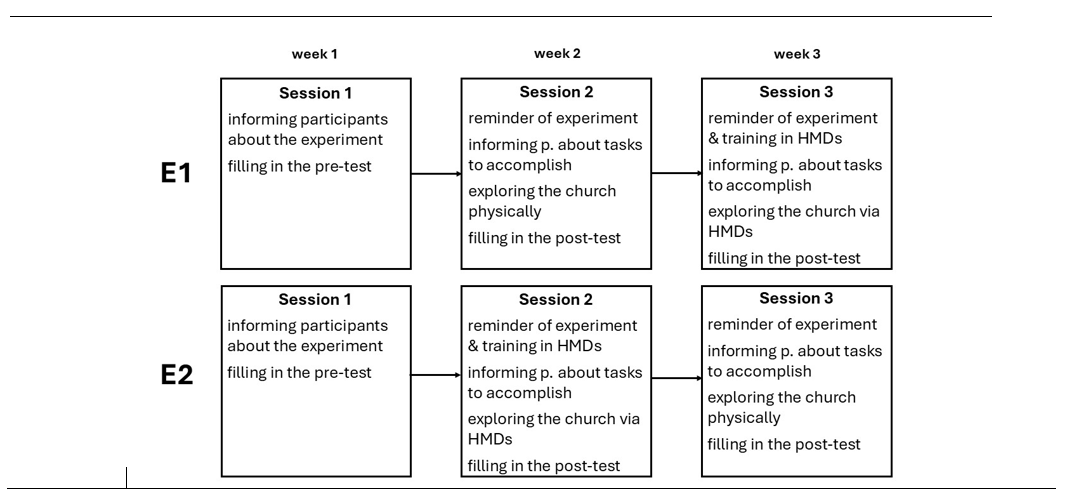
An experimental design with two points of measurement and two treatments was applied. According to Murdoch and Davies (2017), the participants were invited to explore a church building both physically and virtually. Experimental group one first made a physical visit, followed by the virtual visit one week later. Experimental group two started with the virtual exploration and visited the church in person one week later (see fig. 1). In each visit, the students were asked to explore the church and to accomplish four tasks during the visit. These tasks were:
(i) exploring the church’s principal objects (“Look for all the objects that make up a church. Explore them carefully. Think about why these objects are placed exactly where you find them.”)
(ii) imagining an object’s story (“Imagine that one of these objects is telling you its story. Think about what this object could tell you.”)
(iii) exploring one’s favorite spot (“Find a favorite spot in the church. Stay in this spot for at least five minutes. Look around and take in the space. Why is this your favorite place?”)
(iv) exploring a holy spot (“Find a place in the church that you would classify as holy. Think about what makes this place sacred. You should also linger here for a few minutes. If you wish, you can say a prayer [for someone] or remain in silence”)
Note that besides the first task, all tasks were of an affective nature to foster an auratic experience. Furthermore, the invitation to pray is not experienced as invasive in a group of prospective religious education teachers, because this education is of a denominational character in Germany.
Figure 1
Flowchart of the experiment
In both treatments, the students explored the Martini Church in Siegen. Founded in the 10th century, Martini is the oldest known church in Siegen. It is a Protestant-Reformed church and therefore rather modestly equipped. It has the basic features of a church’s interior like the altar, a pulpit, benches, a baptismal font, and an organ, but no paintings on the walls or a decorated ceiling. There is hardly any object in the church hall to distract the visitor's gaze or to confuse their perception. Martini, however, is nicely located in the center of Siegen with some greenery in the churchyard. All in all, Martini is one of the most auratic places in Siegen and therefore perfectly suited for this study.
Moreover, a virtual tour of Martini is available. It has been produced as 3D-Model in a seminar at the University of Siegen. More precisely, Martini was covered with a grid of recording points, each two meters apart. A 3D image of each recording point was taken with the Insta360 Pro 2® camera. These images were then rendered using PhotoShop® software and compiled into a 3D simulation of Martini using 3D-Vista® software. In this situation, visitors in Martini move from spot to spot, with each spot representing a point on the grid of recording points. Movement is possible from one spot to every neighboring spot in the grid. These neighboring points appear in the simulation, and one moves by clicking on the target point with a stick in one’s right hand. Unlike in reality, moving in the simulation is not a steady movement but a form of hopping, being zoomed to the next spot. At each spot, the visitor in the simulation can see what a person would see of the church from this spot in the physical location. Unlike in the physical church, the virtual visitor can click on information at interesting points, which is available either in text form or as a voice memo. Additionally, at some spots like the organ, small pieces of church music can be listened to. All these gimmicks are optional and an add-on to the virtual visit. Odors or sensory impressions, however, cannot be provided in this simulation of Martini. The 3D simulations of Martini were uploaded to 20 Pico4® HMDs.
The virtual tour started outside of Martini and allowed participants to grasp the location of this church within the city center as well as the building’s exterior façade. The church’s interior could be entered through the same door as the one through which the real church can be entered. The first impression of the church hall is therefore more or less identical in both virtual and physical conditions. Inside the church, the virtual visitor is able to choose the path by which to explore the church further: via the central aisle or via the aisles to the left or right of the central one. Again, the condition is fairly similar to that in the physical church, and the virtual exploration simulates all the possibilities of a physical one within the technical options that are possible for non-professionals.
The experiment took place in autumn and winter 2022/23. It spanned three lectures (see fig. 1). In the sessions prior to the first visits, the experiment was introduced to the students. Then the students filled in a questionnaire with socio-demographic variables and information on their use of media, their familiarity with VR, and their assessment of the didactic purpose of VR media in religious education contexts. Finally, the students were assigned to one of the two experimental groups at random.
The first round of visits took place the next week and happened during the regular lecture time (see fig. 1). The group that visited Martini physically met in front of the church, got a quick reminder of the purpose of the experiment, and received a leaflet with four tasks to accomplish. Then, the students started the exploration. The group to visit Martini virtually met in the regular lecture hall and went through the same preparation. Additionally, they were introduced to the handling of the HMDs to minimize technical confusion. After having read through the tasks, which were the same as those of the physical tour, the students started the virtual tour. In both treatments, the students filled in a second questionnaire comprising an instrument on auratic experience after the visit. Those of the virtual group additionally answered some questions on the didactic utility of VR tools for religious education. Given the regular lecture time of 90 minutes, the students had a maximum of about 60 to 70 minutes to visit the church.
The next week, the second round of visits took place with the groups switching places (see fig. 1). The students who physically explored the church the previous week now visited it virtually. And the students who undertook a virtual exploration the previous week met in front of the church to explore it physically this time. Again, after these visits, the students filled in the second questionnaire.
All in all, the church visits lasted between 25 and 60 minutes. There was no significant difference between the duration of stay inside the church if the condition of the exploration is regarded.
Currently, there is no valid instrument to measure auratic experience. Murdoch and Davies (2017) used a list of adjectives but did not report any conceptual background of this list or offer some sort of scale building. To cope with this problem, we refer to Benjamin’s definition of aura as a quality of artefacts (Benjamin, 2021 [1935]). According to Benjamin, the aura of an artefact is defined through the presence of some transcendent or distant reality in the act of experiencing. According to Wagner (2022), in architectural artifacts, such aura is represented by some mystical experience as well as immersion (“Versenkung”). Based on this definition, we measured auratic experience with two validated instruments.
First, the short form of the Mysticism Scale (Streib et al., 2021) was used. This scale is about the presence of some higher reality without using the concepts of specific religious traditions. As such, the mysticism scale is able to grasp the mystical experiences of those people who are spiritual rather than religious as well. The scale comprises three sub-scales representing introvertive mysticism (sample item: “I have had an experience in which something greater than myself seemed to absorb me”), extrovertive mysticism (sample item: “I have had an experience in which I realized the oneness of myself with all things”), and interpretation (sample item: “I have had an experience in which I felt that all was perfection at the time”) (see fig. 2). The short form of the Mysticism Scale has eight items, and the answer scale is a seven-point Likert-type scale (1 = does not apply at all; 7 = applies absolutely).
Second, the Psychological Flow Scale (Norsworthy et al., 2023) was adapted to the church visit. It is composed of the three sub-scales, absorption (sample item: “All my attention was focused on exploring the church interior”), effortlessness (sample item: “I had the feeling that my exploration of the church interior was flowing”), and intrinsic reward (sample item: “The church exploration was satisfactory”) (see fig. 2). These sub-scales perfectly match what Wagner (2022) addresses by “Versenkung”. Each sub-scale is represented by three items and then assessed on a seven-point Likert-type scale (1 = does not apply at all; 7 = applies absolutely).
Figure 2
Theoretical concepts of auratic experience and its empirical components (via Exploratory Factor Analysis)
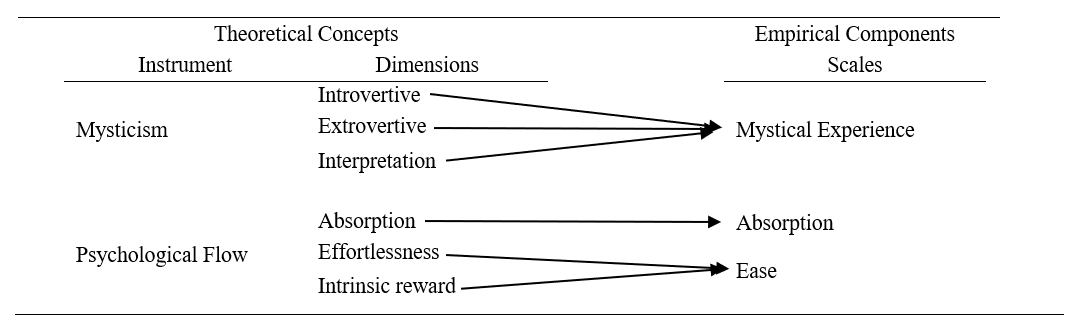
Because the instrument of auratic experience is composed of two separate instruments, its internal structure was checked by exploratory factor analysis (EFA; principal component analyses with Varimax-rotation). Note that every student filled in the instrument twice, which results in 104 datasets. The EFA results in three factors (see fig. 2; for details, see appendix). The first factor contains all items of the mysticism scale and therefore represents some mystical experience during the exploration of the church building. The second factor comprises the items of the two sub-scales of psychological flow, namely those of effortlessness and intrinsic reward. Together, those characteristics define some state of ease, which is the label of the empirical factor. The third factor represents the sub-scale of absorption of psychological flow. It has been labelled accordingly. In consequence, in the following analyses, auratic experience is represented by three dimensions, namely mystical experience, ease, and absorption.
Data was analyzed according to the following steps. To answer the first research question, the three dimensions of auratic experience were turned into manifest variables by calculating the mean of their relevant items; that is, those items that show a factor loading > .50 on the relevant component. The characteristic of each variable was determined by descriptive statistics. The second research question was answered by estimating the effect of the type of visit via t-test with Hedges’ g as a measure of effect size. Hedges’ g was applied because it is correcting the difference in the sizes of the sub-samples. To determine the effect caused by the order of visit, the third research question, a new variable was processed by subtracting the mean of each dimension of auratic experience at measurement point one from the mean of that dimension at measurement point two. Then, a t-test was used with Hedges’ g as a measure of effect size to calculate the effect of order of visit.
According to descriptive statistics, the students hardly had any mystical experience when exploring the churches (M = 2.62, see tab. 1). The two dimensions of ease (M = 4.339) and absorption (M = 4.72) are regarded as ambivalent with a mean value around the center of the response scale.
Table 1
Characteristics of auratic experience in church buildings
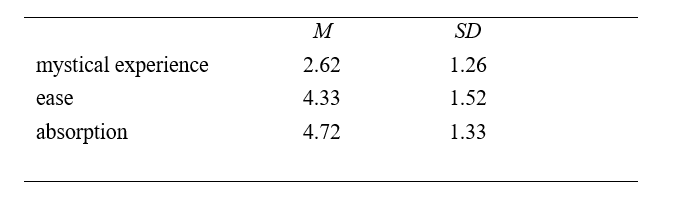
Note: The dimensions of auratic experience comprise both types of visits to the church, namely the visit of a physical church and the virtual visit of a digital representation of this church via HMDs. 1 = not at all; 7 = absolutely.
Table 2
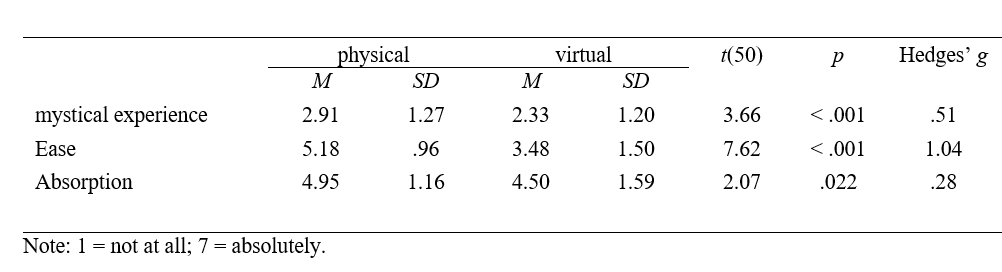
The type of visit influences the auratic experience in all three dimensions (see tab. 2). It is always the physical exploration of the church that stimulates more intensive effects than the virtual one. The largest effect can be seen in the dimension of ease. While the students who explored the church via HMDs report an ambivalent feeling of ease (M = 3.48), the students who have just been inside the church physically demonstrate a solid sense of ease (M = 5.18). Similarly, being physically inside the church causes some mystical experience (M = 2.91), while visiting the church virtually hardly affects such effects (M = 2.33). The effect of the type of visit on mystical experience is medium-sized (Hedges’ g = .51). Finally, the effect of type of visit on the absorption aspect is significant but small (Hedges’ g = .28). Both means are in the positive half of the scale, indicating that both types of exploration immersed the students into the church’s atmosphere to a remarkable degree.
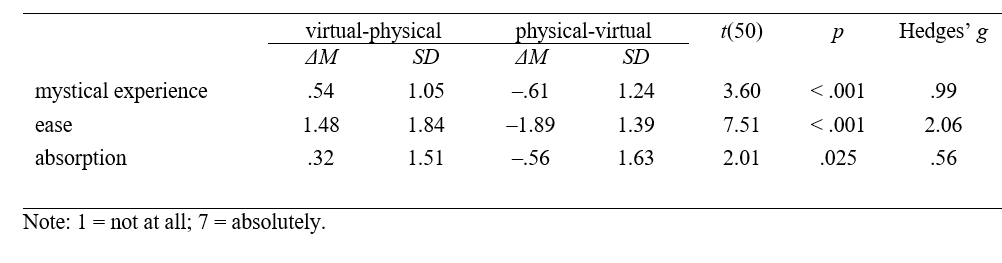
To determine the effect of the order of visits, the mean value of the first visit was subtracted from the mean value of the second visit. A positive value therefore indicates that the effect of the second visit was greater than that of the first, while a negative value indicates the opposite. The results support the previous findings that the physical visit to the church stimulated more intensive experiences than the virtual one (see tab. 3). Those who visited Martini virtually first gained a great sense of ease by exploring this church physically on measurement point two (ΔM = 1.48). Those who were in Martini physically at measurement point one lost much of that sense when exploring the church virtually for the second time at measurement point two (ΔM = –1.89). The same is true for mystical experience (ΔM = .54 to ΔM = –.61) and for absorption (ΔM = .32 to ΔM = –.56), although the effect size of absorption is medium. Remarkably, for all three dimensions, the effect is even more pronounced when switching from the physical exploration to the virtual compared with the reverse (virtual to physical).
Table 3
Change in auratic experience in church buildings for order of visits
This study addresses the desideratum of research in subject didactics, as there is hardly any analysis of affective outcomes regarding the learning object in VR environments to date. Its test case is a visit to a church, because in religious education, explorations of sacred spaces are explicitly dedicated to both cognitive and affective outcomes. Regarding the latter, the aim here is usually to experience the special atmosphere of the space (Rupp & Evers, 2016). In this study, this affective output was measured as auratic experience and operationalized according to the dimensions of mystical experience and two aspects of flow, namely ease and absorption. Note that both aspects of flow were associated with the exploration of the church and not with the technical way to experience VR via HMDs.
The theoretical distinction within auratic experience was partially confirmed by the empirical results. On the one hand, exploratory factor analysis did not yield six components that match the sub-scales of the applied instruments. On the other hand, this analysis did not result in one single component. The latter would indicate that auratic experience is a holistic feeling that cannot be further differentiated. This is not the case. The three empirical factors seem to be indicative in at least two ways. First, flow on field trips does not appear to be an undifferentiated, holistic experience. Instead, the learning object should stimulate different flow experiences, depending on the respective aspect of flow (Nakamura & Csikszentmihalyi, 2002). In our study, these experiences could be characterized as ease and absorption. Note that absorption happened in both conditions, the physical as well as the virtual. There is no plausible reason for why this finding should apply exclusively to field trips in sacred spaces. The different experiences of flow should also apply to field trips to museums, zoos, or science centers. Second, mystical experience has been successfully measured by an established scale. On the one hand, this marks a step forward in terms of the rather basic operationalization of spirituality by Murdoch and Davies (2017). A more elaborate measure of the spiritual aspect of attitude towards the learning object can be applied in educational studies too. On the other hand, the three-dimensional structure of mystical experience as operationalized by Streib et al. (2021) does not appear in the present sample. This may be due to the select sample, but it may also be due to the fact that field trips are not a religious experience in the true sense of the word. The various aspects of mysticism as measured by the Mysticism Scale might be perceived as a comprehensive whole in learning environments.
Based on those empirical scales – mystical experience, ease, and absorption – auratic experience during visits to a church was measured. Such trips stimulate some auratic experience in terms of both ease and absorption, but hardly any mystical experience. The answer to the first research question can be specified by the answer to the second research question: it is the virtual visit not to stimulate any remarkable auratic experience. While there is just a small difference regarding absorption, the differences regarding ease and mystical experience are huge. While a physical trip to Martini stimulates some ease (M = 5.18), such feelings are hardly present in the trip via HMD (M = 3.38). The difference in mystical experience is not as great. Given the fact that there is nearly no such experience in general however, it is the physical visit to cause some of it. Adding on the answer to research question 3 that the order of visit is of no relevance, the study brings about a clear picture: In a trip to Martini, Siegen, affective outcomes regarding the learning object are stimulated by the physical visit to some extent, while the trip via HMD only elicits some absorption. On all three dimensions, the virtual trip is significantly less effective than the physical one.
Based on existing research on the effectiveness of VR in educational settings (Makransky & Peterson, 2021), this non-effect of the virtual tours could be due to the rather low experience of immersion during the virtual visits. In both university sessions in which the virtual trips took place, some students reported mild forms of simulator sickness, and a few had some technical problems with the HMDs. Both challenges should affect both presence and agency, which are the basic factors to facilitate learning outcomes according to CAMIL. The problem with handling the HMDs supports the importance of usability for positive effects of VR in learning environments (e.g. Gerhard, 2023). It could be solved by more intense training prior to the virtual visit. Regarding the forms of simulator sickness, one could argue that the way of moving in the 3D-simulations contributed to this, because it implies zooming from spot to spot rather than steady movement. If so, this cannot be handled by university means, as we used a professional tool to create the simulation (3D Vista®). Some online games like Minecraft®, however, deliberately do not offer a realistic image of the simulated environment, and the players do not report simulator sickness as a result.
Going beyond the research on VR in educational settings, Falk’s and Dierking’s (2000) contextual model of learning indicates that field trips are more effective the more they are embedded into a learning sequence at school. In this study, the exploration of the church building did interrupt the regular lecture, and there was therefore no priming moment regarding any auratic experience prior to the visit. This theory could also explain the rather mild auratic experiences on the physical trips. The missing priming would then explain the low expression of that experience in both types of exploration. Additionally, the missing immersion would explain the even lower expression of the auratic experience on the virtual trips.
From the perspective of religious education, it is particularly worth mentioning that no mystical experience was evoked by either of the trips. The result, namely that virtual trips are even less effective than physical ones, supports the skepticism about the spiritual effects of virtual field trips to sacred spaces (Meyer, 2024). In our study, however, even the physical trip did not stimulate much mystical experience. This is all the more remarkable, as the tasks that the students worked on during the church exploration were primarily related to the auratic dimension of the space. One of the tasks was to explicitly mark a spot as “holy”, which clearly relates to some mystical experience. Even more noteworthy is the fact the students who participated in this study were in the process of becoming religious education teachers and should therefore be familiar with the atmosphere in church buildings to a certain extent. In a previous study, Riegel & Kindermann (2016) showed that the physical exploration of churches is sensitive to such familiarity.
All in all, this study indicates that it is not easy to substitute virtual field trips for physical ones if affective outcomes regarding the learning object are addressed. Even if the trips via HMDs stimulated some absorption and a little less ease, the physical trips turned out to be more effective. This result, however, must be reflected within the limitations of this study. First, the sample is not representative. Given that it is drawn from three university lectures, it represents a convenience sample. As the study did not aim to provide representative insights into the effect of VR on field trips, this is not a fundamental problem. However, the findings should be interpreted with caution. Second, the sample comprises university students. These students represent young adults, not children or adolescents. Specifically, the chosen tasks to be accomplished in the church could be more appropriate to younger students rather than to older ones. Third, as previously discussed, the sample is characterized by some above-average familiarity with the subject matter. However, these limitations emphasize rather than reduce the quality of the findings of this study. It is likely that students who are not as familiar with the atmosphere of the church might show a more pronounced impact, because they do not have some point of reference in mind and might therefore be more open to auratic experience, even when this experience is stimulated by HMDs.
Andersen, M. S., Klingenberg, S., Petersen, G.
B., Creed, P. A., & Makransky, G. (2023). Fostering science
interests through head‐mounted displays. Journal of Computer
Assisted Learning, 39(2), 369–379.
https://doi.org/10.1111/jcal.12749
Behrendt, M., & Franklin, T. (2014). A review of research on
school field trips and their value in education.
International Journal of Environmental & Science Education
, 9, 235–245.
Benjamin, W. (2021). Das Kunstwerk im Zeitalter seiner technischen
Reproduzierbarkeit. In R. Tiedemann & H. Schweppenhäuser
(Eds.), Gesammelte Schriften. Band 1.3: Abhandlungen
(pp. 431–469). Suhrkamp.
Berg, M., & Stolare, M. (2024). School trips to historical
sites: Students’ cognitive, affective and physical experiences
from visits to Auschwitz. History Education Research Journal,
21(1).
https://doi.org/10.14324/HERJ.21.1.03
Biocca, F. (1992). Will simulation sickness slow down the
diffusion of virtual environment technology? Presence:
Teleoperators and Virtual Environments , 1(3), 334–343.
https://doi.org/10.1162/pres.1992.1.3.334
Çaliskan, O. (2011). Virtual field trips in education of earth and
environmental sciences. Procedia - Social and Behavioral
Sciences, 15, 3239–3243.
https://doi.org/10.1016/j.sbspro.2011.04.278
Chavez, B., & Bayona, S. (2018). Virtual reality in the
learning process. In Á. Rocha, H. Adeli, L. P. Reis, & S.
Costanzo (Eds.), Trends and advances in information systems
and technologies (pp. 1345–1356). Springer.
https://doi.org/10.1007/978-3-319-77712-2_129
Cheng, K.-H., & Tsai, C.-C. (2019). A case study of immersive
virtual field trips in an elementary classroom: Students’ learning
experience and teacher-student interaction behaviors. Computers
& Education, 140, 103600.
https://doi.org/10.1016/j.compedu.2019.103600
Cochrane, T. (2016). Mobile VR in education: From the fringe to
the mainstream. International Journal of Mobile and Blended
Learning, 8(4), 44–60.
https://doi.org/10.4018/IJMBL.2016100104
Dalgarno, B., & Lee, M. J. W. (2010). What are the learning
affordances of 3‐D virtual environments? British Journal of
Educational Technology , 41(1), 10–32.
https://doi.org/10.1111/j.1467-8535.2009.01038.x
Dhimolea, T. K., Kaplan-Rakowski, R., & Lin, L. (2022). A
systematic review of research on high-immersion virtual reality
for language learning. TechTrends, 66(5), 810–824.
https://doi.org/10.1007/s11528-022-00717-w
Dörner, R., Broll, W., Jung, B., Grimm, P., & Göbel, M.
(2019). Einführung in Virtual und Augmented Reality. In R. Dörner,
W. Broll, P. Grimm, & B. Jung (Eds.), Virtual und
Augmented Reality (VR/AR): Grundlagen und Methoden der
Virtuellen und Augmentierten Realität (pp. 1–42).
Springer Vieweg.
https://doi.org/10.1007/978-3-662-58861-1
Falk, J. H., & Dierking, L. D. (2000). Learning from
museums: Visitor experiences and the making of meaning .
AltaMira Press.
Ferdig, R. E., & Kosko, K. W. (2020). Implementing 360 video
to increase immersion, perceptual capacity, and teacher noticing.
TechTrends, 64(6), 849–859.
https://doi.org/10.1007/s11528-020-00522-3
Gerhard, D. (2023). Virtual reality usability design.
CRC Press.
https://doi.org/10.1201/9781003261230
Han, I. (2020). Immersive virtual field trips in education: A
mixed‐methods study on elementary students’ presence and perceived
learning. British Journal of Educational Technology ,
51(2), 420–435.
https://doi.org/10.1111/bjet.12842
Huber, S., & Huber, O. W. (2012). The Centrality of
Religiosity Scale (CRS). Religions, 3(3), 710–724.
https://doi.org/10.3390/rel3030710
Jenewein, K., & Schulz, T. (2007). Didaktische Potentiale des
Lernens mit interaktiven VR‐Systemen, dargestellt am Training des
Instandhaltungspersonals mit dem virtuellen System „Airbus A320“.
In Gesellschaft für Arbeitswissenschaft (Eds.),
Kompetenzentwicklung in realen und virtuellen Arbeitssystemen
(pp. 323‐326). GfA-Press.
Jensen, L., & Konradsen, F. (2018). A review of the use of
virtual reality head-mounted displays in education and training.
Education and Information Technologies , 23(4),
1515–1529.
https://doi.org/10.1007/s10639-017-9676-0
Kaplan‐Rakowski, R., Cockerham, D., & Ferdig, R. E. (2024).
The impact of sound and immersive experience on learners when
using virtual reality and tablet: A mixed‐method study.
British Journal of Educational Technology , 55(4),
1560–1582.
https://doi.org/10.1111/bjet.13417
Kaufeld, M., Bourdeinik, J., Prinz, L. M., Mundt, M., & Hecht,
H. (2022). Emotions are associated with the genesis of visually
induced motion sickness in virtual reality. Experimental
Brain Research, 240(10), 2757–2771.
https://doi.org/10.1007/s00221-022-06454-z
Keshavarz, B., & Hecht, H. (2012). Stereoscopic viewing
enhances visually induced motion sickness but sound does not.
Presence: Teleoperators and Virtual Environments , 21(2),
213–228.
https://doi.org/10.1162/PRES_a_00102
Korlat, S., Kollmayer, M., Haider, C., Hlavacs, H., Martinek, D.,
Pazour & P. Spiel, C. (2024), PhyLab - a virtual reality
laboratory for experiments in physics: a pilot study on
intervention effectiveness and gender differences. Frontiers
in Psychology, 2024, 15,
https://doi.org/10.3389/fpsyg.2024.1284597
Kortendiek, B., Mense, L., Beaufaÿs, S., Bünnig, J., Hendrix, U.,
Herrmann, J., Mauer, H., Niegel, J. (Eds.). (2019). Gender-Report
2019. Geschlechter(un)gerechtigkeit an nordrhein-westfälischen
Hochschulen.
https://www.genderreport-hochschulen.nrw.de/fileadmin/media/media-genderreport/download/Gender-Report_2019/genderreport_2019_langfassung_f_web.pdf
Kourtesis, P., Amir, R., Linnell, J., Argelaguet, F., &
MacPherson, S. E. (2023). Cybersickness, cognition, & motor
skills: The effects of music, gender, and gaming experience.
IEEE Transactions on Visualization and Computer Graphics
, 29(5), 2326–2336.
https://doi.org/10.1109/TVCG.2023.3247062
Lanir, J., Wecker, A. J., Kuflik, T., & Felberbaum, Y. (2016).
Shared mobile displays: An exploratory study of their use in a
museum setting. Personal and Ubiquitous Computing,
20(4), 635–651.
https://doi.org/10.1007/s00779-016-0931-y
Lee, C., Gauglitz, S., Hollerer, T., & Bowman, D. A. (2012).
Examining the equivalence of simulated and real AR on a visual
following and identification task. 2012 IEEE Virtual Reality
(VR), 77–78.
https://doi.org/10.1109/VR.2012.6180890
Ling, Y., Brinkman, W.-P., Nefs, H. T., Qu, C., & Heynderickx,
I. (2012). Effects of stereoscopic viewing on presence, anxiety,
and cybersickness in a virtual reality environment for public
speaking. Presence: Teleoperators and Virtual
Environments, 21(3), 254–267.
https://doi.org/10.1162/PRES_a_00111
Makransky, G., & Mayer, R. E. (2022). Benefits of taking a
virtual field trip in immersive virtual reality: Evidence for the
immersion principle in multimedia learning. Educational
Psychology Review, 34(3), 1771–1798.
https://doi.org/10.1007/s10648-022-09675-4
Makransky, G., & Petersen, G. B. (2021). The Cognitive
Affective Model of Immersive Learning (CAMIL): A theoretical
research-based model of learning in immersive virtual reality.
Educational Psychology Review , 33(3), 937–958.
https://doi.org/10.1007/s10648-020-09586-2
Makransky, G., Andreasen, N. K., Baceviciute, S., & Mayer, R.
E. (2021). Immersive virtual reality increases liking but not
learning with a science simulation and generative learning
strategies promote learning in immersive virtual reality. Journal
of Educational Psychology, 113(4), 719–735.
https://doi.org/10.1037/edu0000473
Malone, S., & Brünken, R. (2021). Hazard perception, presence,
and simulation sickness—A comparison of desktop and head-mounted
display for driving simulation. Frontiers in Psychology,
12, 647723.
https://doi.org/10.3389/fpsyg.2021.647723
Markowitz, D. M., Laha, R., Perone, B. P., Pea, R. D., &
Bailenson, J. N. (2018). Immersive virtual reality field trips
facilitate learning about climate change. Frontiers in
Psychology, 9, 2364.
https://doi.org/10.3389/fpsyg.2018.02364
Mavrogiorgou, P., Böhme, P., Hooge, V., Pfeiffer, T. & Juckel,
G. (2022), Virtuelle Realität in der Lehre im Fach Psychiatrie und
Psychotherapie. Der Nervenarzt 93(7), 728-734,
https://doi.org/10.1007/s00115-021-01227-5
Meyer, K. (2019). Grundlagen interreligiösen Lernens.
Vandenhoeck & Ruprecht.
https://doi.org/10.13109/9783666720062
Meyer, K. (2024). Auf dem Niveau von Wimmelbildern? Virtuelle
Religionsstätten und die Möglichkeiten, ihren didaktischen Nutzen
zu steigern. In U. Riegel & M. Zimmermann (Eds.),
Digitale Sakralraumpädagogik (pp. 295–306). Kohlhammer.
https://doi.org/10.17433/978-3-17-043900-9
Mohd Noor Shah, N., & Ghazali, M. (2018). A systematic review
on digital technology for enhancing user experience in museums. In
N. Abdullah, W. A. Wan Adnan, & M. Foth (Eds.), User
Science and Engineering: 5th International Conference i-USER
2018, Proceedings (pp. 35–46). Springer Singapore.
https://doi.org/10.1007/978-981-13-1628-9
Murdoch, M., & Davies, J. (2017). Spiritual and affective
responses to a physical church and corresponding virtual model.
Cyberpsychology, Behavior, and Social Networking ,
20(11), 702–708.
https://doi.org/10.1089/cyber.2017.0249
Nakamura, J., & Csikszentmihalyi, M. (2002). The concept of
flow. In C. R. Snyder & S. J. Lopez (Eds.), Handbook of
positive psychology (pp. 89–105). Oxford University Press.
Norris, E., Shelton, N., Dunsmuir, S., Duke-Williams, O., &
Stamatakis, E. (2015). Teacher and pupil perspectives on the use
of Virtual Field Trips as physically active lessons. BMC
Research Notes, 8(1), 719.
https://doi.org/10.1186/s13104-015-1698-3
Norsworthy, C., Dimmock, J. A., Miller, D. J., Krause, A., &
Jackson, B. (2023). Psychological Flow Scale (PFS): Development
and preliminary validation of a new flow instrument that measures
the core experience of flow to reflect recent conceptual
advancements. International Journal of Applied Positive
Psychology , 8(2), 309–337.
https://doi.org/10.1007/s41042-023-00092-8
Ochs, C., & Sonderegger, A. (2022). The interplay between
presence and learning. Frontiers in Virtual Reality, 3,
742509.
https://doi.org/10.3389/frvir.2022.742509
Petersen, G. B., Klingenberg, S., Mayer, R. E., & Makransky,
G. (2020). The virtual field trip: Investigating how to optimize
immersive virtual learning in climate change education.
British Journal of Educational Technology , 51(6),
2099–2115.
https://doi.org/10.1111/bjet.12991
Pickel, G. (2022). Religiöse Vielfalt als Bedrohung oder
Bereicherung? Ergebnisse des Bertelsmann Religionsmonitors 2017 im
Ländervergleich. Zeitschrift für Religion, Gesellschaft und
Politik , 6(2), 749–779.
https://doi.org/10.1007/s41682-022-00119-y
Plasger, G. (2024). Das evangelische Kirchenraumverständnis und
der virtuelle Kirchenraum. In U. Riegel & M. Zimmermann
(Eds.), Digitale Sakralraumpädagogik (pp. 89–99).
Kohlhammer.
https://doi.org/10.17433/978-3-17-043900-9
Puhek, M., Perše, M., & Šorgo, A. (2012). Comparison between a
real field trip and a virtual field trip in a nature preserve:
Knowledge gained in biology and ecology. Journal of Baltic Science
Education, 11(2), 164–174.
https://doi.org/10.33225/jbse/12.11.164
Radianti, J., Majchrzak, T. A., Fromm, J., & Wohlgenannt, I.
(2020). A systematic review of immersive virtual reality
applications for higher education: Design elements, lessons
learned, and research agenda. Computers & Education
, 147, 103778.
https://doi.org/10.1016/j.compedu.2019.103778
Ragan, E., Wilkes, C., Bowman, D. A., & Hollerer, T. (2009).
Simulation of augmented reality systems in purely virtual
environments. 2009 IEEE Virtual Reality Conference ,
287–288.
https://doi.org/10.1109/VR.2009.4811058
Ramaseri Chandra, A. N., El Jamiy, F., & Reza, H. (2019). A
review on usability and performance evaluation in virtual reality
systems. 2019 International Conference on Computational
Science and Computational Intelligence (CSCI) ,
1107–1114.
https://doi.org/10.1109/CSCI49370.2019.00210
Rauschnabel, P. A., Felix, R., Hinsch, C., Shahab, H., & Alt,
F. (2022). What is XR? Towards a framework for augmented and
virtual reality. Computers in Human Behavior , 133,
107289.
https://doi.org/10.1016/j.chb.2022.107289
Riegel, U., & Kindermann, K. (2016). Why leave the classroom?
How field trips to the church affect cognitive learning outcomes.
Learning and Instruction , 41, 106–114.
https://doi.org/10.1016/j.learninstruc.2015.10.004.
Riegel, U., & Kindermann, K. (2017). Field trips to the
church: Theoretical framework, empirical findings, didactic
perspectives . Waxmann.
Rupp, H., & Evers, D. (Eds.). (2016). Kirchenräume
wahrnehmen, deuten und erschließen . Calwer.
Salman, A. (2023). Field trips and their effect on student
learning: A comparison of knowledge assessment for physical versus
virtual field trips in a construction management course. Virtual
Worlds, 2(3), 290–302.
https://doi.org/10.3390/virtualworlds2030017
Shahab, H., Mohtar, M., Ghazali, E., Rauschnabel, P. A., &
Geipel, A. (2023). Virtual reality in museums: Does it promote
visitor enjoyment and learning? International Journal of
Human–Computer Interaction, 39(18), 3586–3603.
https://doi.org/10.1080/10447318.2022.2099399
Shin, D.-H. (2017). The role of affordance in the experience of
virtual reality learning: Technological and affective affordances
in virtual reality. Telematics and Informatics, 34(8),
1826–1836.
https://doi.org/10.1016/j.tele.2017.05.013
Streib, H., Klein, C., Keller, B., & Hood, R. (2021). The
Mysticism Scale as a measure for subjective spirituality: New
results with Hood’s M-Scale and the development of a short form.
In A. L. Ai, P. Wink, R. F. Paloutzian, & K. A. Harris (Eds.),
Assessing spirituality in a diverse world (pp.
467–491). Springer.
https://doi.org/10.1007/978-3-030-52140-0_19
Wagner, K. (2022). Aura und Architektur bei Walter Benjamin, oder:
Kann Architektur eine Aura zugesprochen werden? kritische
berichte - Zeitschrift für Kunst- und Kulturwissenschaften
, 7-21.
https://doi.org/10.11588/KB.2016.2.88903
Witt, T., & Lindner, K. (2024). VR-Kirchenpädagogik.
Möglichkeiten und Grenzen von VR-Kirchen(raum)erschließungen. In
U. Riegel & M. Zimmermann (Eds.), Digitale
Sakralraumpädagogik (pp. 245–257). Kohlhammer.
Zachrich, L., Weller, A., Baron, C., & Bertram, C. (2020).
Historical experiences: A framework for encountering complex
historical sources. History Education Research Journal
, 17(2).
https://doi.org/10.14324/HERJ.17.2.08
Zhao, J., Wallgrün, J. O., Sajjadi, P., LaFemina, P., Lim, K. Y.
T., Springer, J. P., & Klippel, A. (2022). Longitudinal
effects in the effectiveness of educational virtual field trips.
Journal of Educational Computing Research , 60(4),
1008–1034.
https://doi.org/10.1177/07356331211062925 ">